Showing posts with label rock en espanol. Show all posts

25.8.25

MANÁ FT. SHAKIRA, “MI VERDAD”

28th Feb, 2015


A pair of Nineties veteran acts joining up for a laid-back swayalong feels like the kind of thing that the streaming-era chart had no room for anymore; and the fact that it only went to #1 for a week in February 2015, one of a series of one-week wonders in late winter sandwiched in between monumental chart runs, seems more a product of chance (or perhaps of Billboard tinkering with its chart calculus) than of true blanket popularity. (On the airplay chart, it managed a whole two weeks at #1.)

Not that I'm complaining! While I've been largely cool on Maná in these pages, I've consistently adored Shakira, and maybe predictably, I find that her sweet-and-sour voice is exactly the ingredient needed to pull Maná out of their latter-day doldrums and sound vividly, achingly sincere, like a sharp, high clarinet cutting through thickets of droning strings.

The lyric is constructed on a dialectic of "mentiras" (lies) and "verdad" (truth) -- the verses list all the falsity and betrayal that exists in the world, from cheating lovers to lying politicians, while the chorus calls the eternal romantic "you" the singer's truth, a refuge from the painful deceptiveness at large in the rest of existence. Although in the video, Shakira caresses a visibly pregnant belly (she gave birth to her second child the month before the single's release), transforming the "you" from romantic to parental love. And in the comments on the video, that seems to be the favorite reading: many family relationships and losses are related there.

The bolero rhythm underlying the verses, and the foursquare rock rhythm of the choruses, have their own implications (the tricksy, scheming Afro-Latin tradition versus the open, honest, white-coded sound?), although Maná are a rock band and believe in rock dynamics above everything. But this is their farewell (as of this writing) to this travelogue, so I can't be sorry that they brought on my favorite Colombian ringer to leave a better taste in my mouth than they might have otherwise.

Airplay Watch:

  • Maná ft. Shakira, "Mi Verdad"
    • Discussed above.

21.10.24

CARLOS VIVES, “VOLVÍ A NACER”

13th October, 2012

This is it: the final #1 of the Hot Latin chart as it had been calculated since its beginning in 1986. Despite my ignorant speculation in early entries on this blog, it had always been an airplay chart; commercial singles of Spanish-language pop were uncommon in the U.S. after the 1960s, as label consolidation created pressure to direct consumers toward higher-ticket albums. Where the charts were concerned, radio formats were a rough but workable approximation of audience: if a song was popular in the Black or Latin communities, regardless of actual genre, it showing up on the R&B or Hot Latin charts meant something.

So Billboard shifting, in October 2012, to a streaming-heavy calculation for its flagship genre charts meant that audiences no longer counted. As an infamous illustration, the streaming switchover meant that Macklemore's "Thrift Shop" would hold the #1 spot on the R&B/Hip-Hop chart for months in early 2013, whereas on the R&B/Hip-Hop Airplay chart, which used the old calculation, it peaked at #34. But it had the "hip-hop" tag on streaming services, so that's the bucket it went into, even though the core audience for the music wasn't much embracing it. (And in fact it had more play on rock stations than R&B ones, peaking at #13 on Rock Airplay.)

But the Latin audience, being both more diffuse (Texas, California, New York and Florida all have very different Latin-music histories and cultures, as different as the countries they saw the most immigration from) and coming with a significant language barrier, would be affected differently. I'll be discussing some of those effects in future installments, but the most immediate and obvious would be the virtual disappearance for many years of genre variety from the top of the chart: pending the unexpected, this is the last we will see of accordion-led Colombian vallenato. Urbano -- the useful catch-all term for Latin music derived from hip-hop, dancehall, and electronic dance -- will rule the top of the chart for the rest of the decade, with glacial turnover as whatever song with "Latin" in its metadata is being played most at parties sticks around for months at a time.

Don't get me wrong, that will include a lot of great music. The chart as calculated by airplay gave kind of a false impression: because it combined inputs from widely different audiences (Puerto Ricans and Dominicans in New York, Cubans in Miami, Tejanos in Texas, Chicanos in Los Angeles, not to mention all the rest of the Hispanic diaspora across the country), it actually delivered more genre diversity than individual listeners were likely to experience from their preferred radio stations. Which of course made it ideally suited for my purposes, as a genre-agnostic magpie wanting to get my arms around as much Latin music as possible. But we've already seen how the airplay chart had diminished reggaetón and other forms of urbano ("Gasolina" getting stuck at #17 while a Juanes rock anthem reigned at #1 is the canonical example) -- and urbano is going to be some of the most exciting and interesting music of the 2010s and 2020s, so getting to look at it in all its explosions and contradictions is going to be fascinating.

But before that, a farewell to Carlos Vives, who will not, as of this writing, be gracing this travelogue again (the closest he will come is a duet with fellow Colombian Shakira in 2014, which will stall at #2 behind a third Colombian; but that's a ways off yet). The chart that started with the Spanish Rocío Dúrcal and the Mexican Juan Gabriel has seen many shifts in taste and fashion over the course of its young life, and if we had to have a valedictory for the past twenty-six years from someone who has been a regular presence for the past thirteen, you could hardly ask for a better selection. Always pleasant to hear from, with one foot firmly planted in the soil of local tradition but one eye always cocked to the horizon for the freshness and modernity of international pop success, he's a Latin Grammy favorite who has aged gracefully into an upbeat, avuncular sound that challenges no boundaries and invites everyone into the jolly, communal celebration.

"Volví a Nacer" (I was born again) is a love song said to be inspired by Vives' second wife, Claudia Elena Vásquez, who married him in 2008. Like so many of the love songs we've looked at over the years, it's replete in hyperbolic expressions of devotion and achievement for the sake of the beloved, the kind of vows a medieval knight-errant would recognize as proper to his lady love. Of course the religious symbolism of the title is present (that too is very medieval, which is another way of saying Catholic, which is another way of saying Latin), but it's submerged in the more human anxiety of whether the lover will remain with him.

The music, swelling from piano ballad to vallenato jig to rock & roll guitar heroics, is similarly a wide tent, with massed voices in the chorus just begging for a singalong. If it doesn't quite convince me to sing along here in the fall of 2024, that may not be its fault: the more muted, paranoid atmostphere of the 2020s can't help being a little skeptical of populist bonhomie. While I don't doubt Vives' sincerity, it's not just the sturdy, gospelly uplifting chords that end up sounding a little naïve.

14.10.24

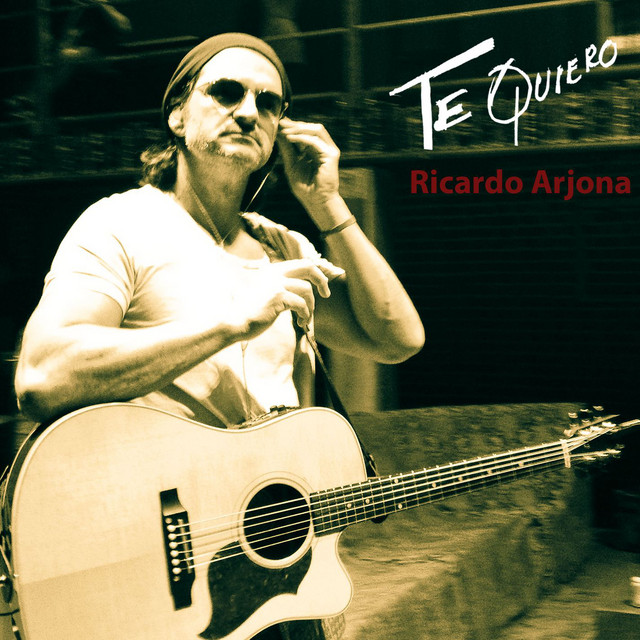
RICARDO ARJONA, “TE QUIERO”

22nd September, 2012


I loved Arjona's first #1 from the Independiente album, which I called "a literary prank in pop-song clothing," the bracingly cynical "El Amor." But it's the rare pop craftsman who entirely refuses to acknowledge on which side his bread is buttered, and this, the fourth single from the album, is a straightforward love song, with less of the usual literary wordplay and more simple sentiment than he's ever deployed in this travelogue before. It's as if he knew it would be his last chance to spend a week at #1 before the chart changed over to streaming data, and so he gave his fans the big anthemic I-love-you song they wanted -- and the video underlines this with a live rendition in Buenos Aires, with thousands of beautiful young Argentines caught on camera singing along with tears in their eyes.

Sad to say, it leaves me almost entirely unmoved -- I've made my criticisms of Arjona's very standard rock-derived production and singing styles before, and this performance lives up to every one of them. As with all Arjona songs, the pleasures are in the abstract, intellectual construction of the songs and not in the bodily surge that carries me along with them.

Because there's not none of that literary wordplay: but because it all circles tightly around the very simple phrase "Te Quiero" (I want/love you), there's less to say about it. The ultimate effect is that of a Leonard Cohen song being performed by late-period U2: the mismatch between the intelligent self-composure of the lyrics and the generic overwroughtness of the performance is kind of interesting, but not so much that it bears repeated exposure.

Only one song left before streaming data takes over and pummels the relatively diversity of genre, nationality, generation and audience that the old Hot Latin chart once championed into an indistinguishable paste. Let's hope it's a good one.

7.10.24

MANÁ, “HASTA QUE TE CONOCÍ”

15th September, 2012


One of the few upsides of having taken forever to get through this blog is that songs that had yet to be released when I began it are able to force me to revisit and revise some of the ill-informed, unconsidered, and shallow takes I gave in the first few years of its existence.

Juan Gabriel, first as a songwriter and then a week later as a singer, was the auteur who more than any other defined the first five years of Hot Latin #1s, and I never really appreciated what made him great when I was writing about those years. It was not until his final #1 as a singer in 2001 -- which I only got to after his death in 2016, when I was finally capable of understanding the full breadth of his achievement -- that I really gave him his due in these pages.

But it wasn't in these pages, but in the waning years of the music-writing community on Tumblr, that I really revised my understanding of Juan Gabriel: my somewhat bellicose and overheated in memoriam included twinned valuations of "Debo Hacerlo," a #1 which I had done less than justice to back in 2010, and its immediate predecessor, the epic-length power ballad "Hasta Que Te Conocí," which peaked at #2 and so which I had been ignorant of until his death, when I dove into his discography and learned, to my mortification, that "Debo Hacerlo" had always been a kind of Frankensteined remix of "Conocí," the kind of obvious context that any Spanish-language listener in the eighties would have known immediately and which this blog would theoretically exist to elucidate for English-only readers. I've mentioned before how embarrassed I am by the first two decades covered by this blog, but that entry might be the one of which I'm most ashamed.

I'll go ahead and reproduce my post-mortem Tumblr blurb for "Hasta Que Te Conocí" here, in order to give a starting point for considering Maná's 2012 cover:

In 1986, he had no worlds left to conquer. (The savage wilderness to the north had never counted; it would have been beneath his dignity to mouth their crude, unliterary tongue.) The supreme center of Mexican music, he moved with ease between the internationalist pop of the capital, the classicist ranchera of the provinces, and the party-hearty rock of the border. His songs were sung by Spanish divas and juvenile sensations, he was the face and voice of the television age. With no horizontal territory left to claim, he could only build up: to pierce the sky with monuments to his own emotional torment and eccentric but undeniable musicianship.

“Hasta Que Te Conocí” is an sprawling pop edifice built from ranchera materials, but on a plan only Juan Gabriel could have conceived. An extended ambient ballad built on folkloric repetition and declarations of prelapsarian innocence serves as introduction, his perfectly-timed phrasing the only element of rhythm. When he finally pivots to the title phrase, tight mariachi strums and doomy horns build tension as he lays out his accusation of heartbreak and betrayal. It winds tighter and tighter, until the whole arrangement rises into an extended march-cum-tango-cum-montuno, horns pealing dolorously as Gabriel’s voice raises at last in emotional refusal, the tightly-constructed argument thrown out the window for a repeated, sobbing “no te quiero verte más.” The original studio version is stunning enough, but for the full, extravagantly emotional, experience see his epochal 1990 concert version or even his rendition from earlier this year, arranged and conducted by his longtime champion, composer Eduardo Magallanes.

(I will leave my reevaluation of "Debo Hacerlo" for the clickthrough; I may even have more to say later this year thanks to assorted music nerd challenges on Bluesky.)

Despite my insistence that only Juan Gabriel could have conceived of or pulled off the weird, ungainly, intensely personal structure of "Hasta Que Te Conocí" (tr. "Until I met you"), it's been a frequent target for cover versions in the years since 1986, much in the way that similarly extravagant slabs of high camp in the Anglophone canon like "Bohemian Rhapsody" or "Total Eclipse of the Heart" have been. Merengue, rock, and hip-hop versions all reached the lower reaches of the Hot Latin chart between 1987 and 2009, but the most successful covers would be Marc Anthony's faithful 1993 salsa cover (which reached #13) and, of course, this 2012 rendition by veteran rockers Maná.

I've been very hard on Maná in these pages, especially their latter-day resurgence as a mainstay of the #1 spot -- and it's a little comical that I implied they were in some way antithetical to Juan Gabriel in their first appearance here, given the fact that this cover was waiting for me -- but I have to admit that this is a sensitive, well-delivered cover, primarily in gentle bolero time until they go all Santana on a montuno coda, with Fher keeping his dudely rock bellowing to a minimum. But I can only come to that conclusion after spending weeks away from Juan Gabriel's original: when I listen to them back to back, Maná's limited emotional landscape and unimaginative rock instrumentation stand out in stark relief.

I have no memory of hearing this on the radio at the time, but like so many entries this year, it was only at #1 for a week: the last grains of sand of the airplay-only Hot Latin chart are running out fast.

24.7.23

JUANES, “LA SEÑAL”

5th May, 2012


The reign of "Ai Se Eu Te Pego" at the top of the chart in the spring and early summer of 2012 was interrupted for only a week by a familiar face in a new context.

The old 1990s MTV Unplugged series, which had run its course in the US by the turn of the millennium, was kept alive mostly in international markets, where live music still had some youth-culture cachet; Juanes' edition, recorded February 1st 2012 in Miami Beach, isn't even listed on the series' English-language Wikipedia entry. The resulting album was his third live album overall, and the catalog of hits he played that night was deep, and frequently documented here. But "La Señal" was new, and as a single it struck enough of a chord with the Spanish-language radio audience that it nudged past Michel Teló's bland come-ons with its own bland platitudes.

We've seen a lot of men with guitars ruminating on life over the years here, and Juanes is no Alejandro Sanz, Ricardo Arjona, or Juan Luis Guerra (he's closer to Maná's Fher or Luis Fonsi). "La Señal" (the sign or the signal, but it could also mean the omen, portent, or signpost) attempts to reach for Greater Meaning, but all it has to do it with is the stripped-down language of rock, and ultimately Juanes' rhythnic capabilities are greater than his poetic ones.

But those rhythmic capabilities shouldn't be counted out. "La Señal" is clearly the product of a post-Jason Mraz world, and the unusual arrangement (a violin takes a solo as though this were the Dave Matthews Band) makes the song more sprightly and energetic than the bathetic lyrics would suggest. It's still ultimately a confused, inarticulate song stringing together longstanding rock tropes (freedom, desire, love, the road) into a mishmash of wants and demands, but it sounds great while it lasts.

Apparently Juan Luis Guerra was the producer for the live set and album, which may be part of why it sounds so great; but I'm petty enough to wish he'd taken a pass at the lyrics, too.

21.11.22

MANÁ FT. PRINCE ROYCE, “EL VERDADERO AMOR PERDONA”

10th December, 2011


Over the years that I've been conducting this travelogue I have occasionally run into cases where it's not clear which version of a song is supposed to be represented on the chart, since multiple versions are in circulation at once. Billboard lists this chart entry as "Maná Featuring Prince Royce," but from my memories of Latin radio in Phoenix in late 2011 and 2012, Maná's original plodding dirge was played far more frequently; I only vaguely recognized the bachata-con-Royce version when listening to it to write this.

Of course, other markets presumably had different experiences: New York radio, for example, would surely have promoted the Dominican element over the Mexican. And one of the charms of the old airplay-only method of chart calculation was that the multiple versions and remixes playing on various slightly different radio formats could be collapsed into sharing a single chart entry. Which became part of the strategy for releasing multiple versions to multiple formats at once: get enough traction on each, and your song would do all the better on the overall chart. But I don't know that I've heard a more awkward combination of genres  than this power ballad-meets-airy bachata that Billboard considered the primary version in 2011.

Ten years later, the YouTube video for Maná's original has more than three times the views than the version with Prince Royce interpolating half the lines in his lovely, emotionally vacant falsetto does. It's easy to read this collaboration as a cynical move: "El Verdadero Amor Perdona" (True love forgives) was the third single from Drama y Luz, but didn't look likely to replicate the success of its two predecessors, both of which appeared here, so goosing its chances by adding a flavor-of-the-year prettyboy singer and a generic bachata bed (the hoary rock en español band played much better bachata when Juan Luis Guerra was their guest) for a conveniently-timed "deluxe edition" of the album worked to keep Maná's streak of Hot Latin #1s alive.

As you may have gathered, I'm not a big fan of either the original or its bachatification. The chorus' rewrite of 1 Corinthians 13 to beg a betrayed lover to take the singer back is emotionally manipulative in both the good sense (pop artisans know how to use chord changes and tension-and-release dynamics to engineer feelings), and the bad ("if you don't forgive me, you never loved me"-ass argumentation). It's easier to take the song less seriously when Prince Royce sings half the lines in his glib, cherubic manner, which might make it even more insidious.

Not that demanding perfect moral rectitude from pop is a meaningful, much less achiveable, goal: pop exists to embody emotions, and the emotion embodied here is a widely experienced and expressed one. My complaint is that it fails to make that emotion irresistible to me: it sounds just as stunted and navel-gazing as it is.

3.10.22

MANÁ, “AMOR CLANDESTINO”

27th August, 2011


The last time Maná had two singles in a row go to #1 was in 2006, when "Labios Compartidos" and "Bendita Tu Luz" followed in quick succession. That was during the first flowering of reggaetón, and my reaction was a simmering displeasure at such old-fashioned rock being dragged out again as if in counterpoint. Here in 2011 it is a similarly dance-friendly moment, with Maná appearing between big splashy international hits, and it feels more than ever like a kind of quiet culture war.

"Lluvia al Corazón" had sat at #1 for three weeks in the spring, and "Amor Clandestino" only popped in for a week; and not to suggest that my tastes are representative of the broader Latin Pop audience's, but I kind of liked the former, and think the latter is Maná at their self-important, pretentious, fauxthentic worst.

Opening with Fher's extremely basic harmonica skills signals that this is going to be a bluesy, authentic rock song, but there's no groove here, just a succession of dramatic builds, key changes and string sections shoring up the slow bits while Fher moans about love that has to be conducted in secret for unspecified reasons. The video gives a number of specifics, none laudable: one person is cheating on their partner, another is a tutor coming on to their student, a third is falling in love with a sex worker trying to keep it professional. The lyrics are certainly in a tradition of self-involved love poetry in which men bemoan the circumstances that prevent them from loving openly and look forward to the ever-delayed day in which they will be allowed to.

Could it be read as a closeted gay song? Of course, and that's the only thing that redeems it, and makes it feel like it's participating in the pop ethos of the 2010s. In the video, a woman looking like she's going towards Fher but instead kissing another woman in an extremely male-gaze shot is the closest we get.

The band is visibly aging, and the concurrent transition to HD videos does them no favors. Still, the next Maná single will also appear here, a record that I believe only Enrique Iglesias has matched. And of course, some day I'll be sorry not to have Maná to kick around any more.

22.8.22

MANÁ, “LLUVIA AL CORAZÓN”

2nd April, 2011


I've had plenty of criticisms of Maná to make in these pages, and this song is far from making a convert of me: musically it's just as generic and earnest and toothless as all the rest of their #1s. And maybe it's just catching me in a particularly receptive mood; but the sentiment of the song for once matches the heroic-inspirational tone of the instrumentation, and also is actually a noble (if still inevitably limited and flat-footed) sentiment.

"Lluvia al Corazón" means "rain in the heart," and the thrust of the lyric, that a woman (possibly a lover, though she needn't be -- in interviews Fher said she could also be a sister, or a friend) is experiencing depression or worse and expressing suicidal thoughts, and the singer's response is to be with her, to help her through it, and to give her hope. As a therapeutic strategy it's insufficient and probably even harmful in parts (the line "si te vas así yo moriré" (if you go like this i'll die) is at best ill-considered), but I've been so down on Maná that even their hearts being the right place, however clumsy they are about it, is a pleasant surprise.

But then again, maybe that's just my own sentimentality about depression speaking. I was less forgiving of bathos at #1 when the subject was neglectful parenting or domestic abuse, after all. And Maná's generic rock is no better, theoretically, than Franco de Vita's generic pomp or Héctor el Father's generic moody reggaetón; but I have used self-important rock to feel better during depression, in ways I have not used other kinds of self-important music, so once more I spend a Maná entry talking about solipsism. But for a change, this time it's my own.

15.11.21

JUANES, “YERBATERO”

 4th September, 2010


We haven't heard from Juanes in two years, and given the blandified, soothingly jangly direction that so many rock-inflected male singers have had success with since his last rock romántica #1, it would be easy to assume he would fall in line. But from the opening notes, with a crisply distorted blues guitar riff, sharp handclaps, and cumbia scrape, it's apparent that Juanes is here to actually rock.

He's still in love with 70s rock signifiers, but the tropical percussion keeps him light on his feet, and his choice of lyric -- "Yerbatero" literally means "Herbalist," and the song is sung in the voice of a traditional plant-based healer from Latin American indigenous traditions, whose "medicines" soothe the heartache of romantic disappointment by inducing euphoria and altering consciousness -- breaks more sharply with the traditional love-song lyric than he ever has before.

It's easy enough to read "Yerbatero" as being exclusively about marijuana, and the Spanish-speaking stoner audience alone was probably enough to send it to #1, but the byproducts of other indigenously-cultivated plants, from agave to psilocybin to coca to ayahuasca, fit the lyrics just as well, and the lightly psychedelic music video, as well as the guitar tone's imitation of psych-era UK rock, suggest a more generalized valorization of expanded consciousness. But even for the non-indulgers, the sharpness of the rhythm, melody, and song structure are enough to make this the best rock 'n' roll song to have hit #1 in years, probably since Juanes' own "La Camisa Negra", possibly since "Ciega, Sordomuda", and maybe even, depending on the strictness of your definition, ever. 

It reigned for only a week before ceding the floor to "Cuando Me Enamoro" again. Which is appropriate: in the broader scope of Latin Pop history, it's a footnote, a glib, self-indulgent appropriation of indigenous culture by a white singer in a very rock tradition; but as rock fades from not just playlists but memory itself, an old white rock-bred listener like myself can't help appreciating its energy and sheer joyful noise.

18.10.21

DIEGO TORRES, “GUAPA”

 29th May, 2010


The more things evolve and expand on the Hot Latin chart, the more the white male rockers on it remain entirely unchanged. Although Sin Bandera only had one #1 hit, their influence remains omnipresent: Noel Schajris co-wrote this song, perhaps the most uptempo thing he's been involved with that we've encountered.

We haven't encountered Diego Torres before, even though it feels like we have: Luis Fonsi, David Bisbal, Cristian Castro, and even the last few songs from Alejandro Fernández all sound pretty much like this, which is to say they sound like every generic post-R.E.M. rock act to get radio play since 1990. True, the opening notes suggest a groovier, bluesier track than it ends up being, and Torres plays the trad rocker game at least as well as Maná: the Motown stomp on the chorus is particularly attractive. But ultimately it still feels disconnected from and irrelevant to the more current sounds on the chart, even the centtury-old banda formations. The generic love-song sentiments, in which he compares his lover to a guardian angel who gives him wings, don't have anything to do with the bouncy music, and both have equally little to do with the broody video, in which Torres plays his own guardian angel who helps him undergo a generic Hollywood emotional catharsis.

Torres is a second-generation pop star in Argentina: his mother, Lolita Torres, was a popular film actress and singer during the Perón years, specializing in the Spanish and Argentine folk repertoire. His first band was formed in 1989, but he's been widely popular in Argentina since 1992, and had solidified his international reputation by 2000. This will be his only visit to the #1 spot unless the future is less youth-oriented than the present: his 2021 album presents him as an elder hippieish statesman of Latin pop, lending rockstar credibility to his younger urbano guests and getting world-music cred from the guests his own age.

20.9.21

ALEJANDRO FERNÁNDEZ, “SE ME VA LA VOZ”

6th February, 2010


We haven't heard from Alejandro Fernández since 2004, and so much has changed since then. Maybe the most obvious change is signalled by the fact the single for "Se Me Va la Voz" (losing my voice) was supported by two remixes: a bachata one featuring Héctor Acosta, and an urbano one featuring Tito El Bambino. What we're missing, maybe more obviously from Alejandro Fernández than from anyone else, is a Mexican regional version. But that's because "Se Me Va la Voz" was the second single from Dos Mundos, which was a double album released as Dos Mundos: Tradición (a ranchera record) and Dos Mundos: Evolución (a modern pop/rock record). The first single, "Estuve", was from the Tradición side, and covers much the same themes, athough in a classicist black-and-white video compared to the hypercontemporary, moody pop/rock of "Voz."

"Se Me Va la Voz" was written by Roy Tavaré, a Dominican-born journeyman singer, songwriter, and arranger based in Miami, and produced by Áureo Baqueiro, a long-serving Mexican producer who was responsible for Sin Bandera's signature sound from nowhere. Comparing it to the sound of "Estuve" is instructive: Fernández sounds painfully generic and buried beneath the rock-band swell of the production here, where in the ranchera song his voice is given the sonic space to resonate with the superb technique I first admired him for way back in the late 90s.

Insofar as the song means anything more than "here's Alejandro Fernández singing a rock-inflected song" (complete with fourth-generation Beatlesesque na-na-nas), it's a song of romantic longing, the singer losing his voice because of desire for an unattainable woman. The fact that it ports over so easily to bachata and reggaetón is itself a cautionary sign: nothing about it is intrinsic to its form, and it just as easily slips out of the mind as it slipped into the ears, a one-week wonder at #1.

As of this writing, it's the last we'll hear from Alejandro Fernández: his one-time rivalry with the other second-generation pop pinup has been definitively won by Enrique Iglesias, whose comfort with the limited range and aggressive egotism of contemporary production far outstrips Fernández's. He remains an enormous star, but the contortions necessary to remain relevant in an ever-increasingly pop-focused market are beyond him. Ave, Alejandro.

23.8.21

ALEJANDRO SANZ FT. ALICIA KEYS, “LOOKING FOR PARADISE”

21st November, 2009


First Shakira, then Nelly Furtado, now Alicia Keys popping up at the top spot on the Hot Latin chart -- I was not, in 2009, aware enough of trends or discourse to realize that this was not representative of a new flourishing in Latin pop, but rather the end of an era in mainstream US pop. All three women had broken through into Anglophone stardom in 2001, with "Whenever, Wherever," "I'm Like a Bird," and "Fallin'," respectively; but eight years later, none of them remained at the top of the Anglophone heap, and the more forgiving Latin charts provided a graceful descent from their 2000s-era peaks.

That's one way to look at it, anyway, and probably the one that the Anglocentric readership of this blog (such as it has), with their knowledge that Furtado and Keys have been irrelevant chartwise for the last decade, plus Shakira having mostly disappeared from Anglo airwaves, would probably naturally assume. The way I looked at it at the time was no doubt idealistic, and probably also condescending to the already rich history of Latin pop: I thought maybe it presaged more interconnection between the English- and Spanish-language sides of the industry, a world in which songs largely in Spanish could have as much chance with English-speaking audiences as songs with the amount of English as this one had had with Spanish-speaking ones.

I wasn't wrong, necessarily -- but it took longer than I expected, with a heavy swing towards masculine voices in both Spanish-language and English-language chart pop, to happen. A kind of masculinity that Alejandro Sanz, gruff and limited as his voice is compared to Keys' professionally liquid tones, could not represent. His name is before the "Ft.," and the single was taken from his album Paraíso Express, but Keys' is the first voice you hear in the duet and arguably makes the most impact in the song. Which fits in fine with Sanz' past performance here: he's a great collaborator who knows how to make his duet partner stand out. The jangly backing track was supposed to evoke the British Invasion of the Sixties, but it sounds to my ears more like the commercial jangle of post-R.E.M. Nineties bands like Gin Blossoms. Which is fine (I loved the Gin Blossoms when I was fifteen and they were all over the radio), but by belonging to neither world it only emphasizes the difference in tonality and tradition between Sanz, with his flamenco-derived rasp, and Keys, with her polite R&B dramatics.

Of course I've been excited in these pages before about songs that mash global musical traditions together, and there's a spark of that here, but it never fully catches into a full conflagration. Maybe Alicia Keys is too limited a singer, maybe Alejandro Sanz is too polite to push her, maybe they're both simply taking the easy route: but even the straightforward, literal English lyrics and the cerebal, conceptual Spanish-language ones seem like both of them are singing past each other rather than to each other, much less together. Whatever the future of Latin pop is, it's not this.

16.8.21

DAVID BISBAL, “ESCLAVO DE SUS BESOS”

31st October, 2009


The continued popularity of David Bisbal continues to confound me. I guess if I think really hard about it I can find similar music that meant something to me around roughly the same time: the production isn't a million miles away from Kelly Clarkson's epochal "Since U Been Gone," a good five years earlier, and there was a Hollywood Records wave of rockish teenpop around this time, from which Selena Gomez and the Scene and the Jonas Brothers have aged the best. But Bisbal was a full-grown adult; he turned 30 in 2009, and his larynx-shredding sincerity remains ungainly to Anglophone ears.

I had an ear glued to Latin radio at this point, but if I ever heard this song there it slipped out of my brain just as quickly as it entered. I'm tempted to attribute this unfamiliarity to the solid good sense of the Phoenix-area Latin market, too Mexican and working-class to give much shrift to a Spanish prettyboy; but my own anti-rockism by now was probably even more salient. I've never had any compunction about switching stations on the thinnest pretext.

"Esclavo de Sus Besos" means "slave of her kisses," and it's a typical Bisbal song in that it presents him as unable to fully commit to his current love because he's still hung up on the previous one. Of course the literate, sensitive lyrics put it more sympathetically than that: the title metaphor is a hyperbolic one, but entirely in line with poetic usage. And relistening I can see how the ebb and rush of the music, a slick combination of jangle-pop and hair metal, could propel the listener deeper into their emotions if they were feeling themselves in a similar situation: it's expertly crafted by people who know their business. But it doesn't move me.

9.8.21

NELLY FURTADO, “MANOS AL AIRE”

12th September, 2009


If "Loba" made me excited about the Hot Latin charts, "Manos al Aire" (hands in the air) made me intrigued. If the charts were this wide open for being crashed, what else might not appear? It's one of the most unusual crossovers we've seen throughout this travelogue: a Canadian singer of Portuguese descent had a Latin #1 without an equivalent English-language version. Wikipedia says, incorrectly, that she "was the first North American act to have an originally written Spanish song reach #1," and despite the error (even if you don't count Mexico as North America, Selena was Texan born and bred), it's a notable achievement for someone who only learned Spanish as an adult to have a hit with a Spanish-language song.

A lot of that is due to her co-writer, Afro-Cuban singer and instrumentalist Alex Cuba, who grew up in the Havana area but emigrated to British Columbia as an adult and was a regular winner of Juno awards for "world music" in the 2000s. But Furtado was smart enough to refuse to translate the song to English, because the poetic idioms of Spanish and English are different enough that a lovely Spanish-language song about surrendering to love could sound bathetic or self-loathing in English.

The plastic sound of the song, all crisp electronic drums, repetitive palm-muted acoustic guitar chords, and soaring ersatz string sections, was extremely in vogue in the late 2000s, and in its moment sounded a bit like Anglophone pop crashing Hispanophone pop, productively. Furtado's previous record, Loose, had been a smash on the strength of the Timbaland collaborations "Promiscuous" and "Maneater," which were so rhythmically slippery that her limited voice could just be another texture within the soundscape, but it had also contained Spanish-language collaborations with Calle Ocho and Juanes (again). neither of which troubled the Hot Latin chart; for her 2009 Mi Plan, an all-Spanish-language album (and her first after going independent), she gathered collaborators like Cuba, Lester Mendez, and Julieta Venegas to try to solidify her presence in the Latin market.

It worked, insofar as "Manos al Aire" was #1 for four weeks in the fall of 2009, the album went platinum within a month of release, and Furtado won a Latin Grammy for her pains. But her attempts to return to the English-language market in 2012 and 2017 were met with a stony reception, and she has made no further gestures in Spanish since. Perhaps she's wisely sitting out the streaming era, which as one of the surprise winners of the CD era, she can presumably afford to do.

Twelve years later, "Manos al Aire" no longer sounds as revelatory or heart-gripping as it did back when it was my only companion hurtling through the freeway around Piestewa Peak on my way to work. It sounds thin and clipped, all sharp angles and unconvincing sentiment. A surrender to its joys would be a surrender to nostalgia, and I'm wary enough of the people I used to be that I'm suspicious of that. I still love that it happened; three years later, it could not. And I want to squeeze every last drop out of my affection for these years while I can.

16.3.20

PAULINA RUBIO, “CAUSA Y EFECTO”

27th June, 2009

Wiki | Video

The difference in my affection between last week's entry and this one is no doubt entirely due to my once and future identification as a music nerd: dudely pile-up power ballads are terminally uncool, while sexy sassy glitter-schaffel power pop was always cool, and even more so in the 2000s, when the internet's breaking open of pop history gave muso identification with revivalist microscenes more fashionable cachet than ever before (or, as history has continued to evolve past retromania, since).

"Causa y Efecto" (cause and effect) is a straight-up glam-rock song, something that T. Rex or Suzi Quatro might have sung in the 70s, only with shinier post-millennial production and Rubio's practiced pop-idol charisma in place of anything too alarmingly fey or aggressive. Her 2009 album Gran City Pop was one of my favorite pop albums of the year, in part because it was the year I went all-in on listening to current pop after a decade spent immersing myself in music history, and Rubio was engaging with both current pop and pop history in a charming, totally confident way.

In the video, she intentionally evokes the Blondie of Parallel Lines, posing with her band in suits and skinny ties, and a general 1970s nostalgia suffuses it (roller skating! Eames chairs! hippie dress), a nostalgia that Rubio herself is just old enough to experience. But it's a 2000s song too, which means that it's a song about a woman kicking a man who thinks he controls her to the curb: the lyrics taunt a former abusive lover with her independence from his emotional manipulation and her own new-found power to hurt him instead.

My affection for this song is certainly nostalgic, and was even when I first heard it in 2009, as a music nerd who loved glam rock, 70s pop, and 2000s pop with the schaffel beat. (Goldfrapp's "Ooh La La"! Kylie Minogue's "2 Hearts!" Pink's "So What"!) I have no idea how it would strike a listener with no history with or affection for any of that background; possibly as catchy but slight, or as raucous in an old-fashioned way, without any of the slinky smoothness of contemporary urbano. However it struck the Latin audience as a whole, it was #1 for five solid weeks: enough people loved it as much as I did to earn Paulina another notch on her belt. We'll see her again, just before the streaming era buries everything quirky. These remaining years of heterogeneity are precious.

17.2.20

FANNY LÚ, “TÚ NO ERES PARA MÍ”

25th April, 2009

Wiki | Video

When Fanny Lu first appeared here a little under two years ago, I talked about how her debut, "No Te Pido Flores," was the stronger and more iconic song than the song with which she first went to #1 on the Hot Latin chart. But this one leaves "No Te Pido Flores" in the dust.

In fact, I'm hard-pressed to think of the last time we had such a hard-hitting, compressed, machine-tooled POP song at #1. "Ni Una Sola Palabra"? "Suerte"? "Livin' La Vida Loca"? And it's still fully tropipop, that faintly embarrassing middle-class Colombian combination of vallenatio, cumbia, merengue, and pure pop; but taken at such a driving pace that it's practically pop-punk. There's even a pop-punk guitar solo rising up out of the accordion/drums/guacharaca stew late in the song.

And like a good pop-punk song, it's focused with sneering intensity on a cutting dismissal of a would-be lover. "Tú No Eres Para Mí" means "you are not for me," and the verses' detailing of it's object's fantasies of himself as a romantic lover are gleefully smacked upside the head by the chanted, headlong chorus in which she wants him to understand that he isn't for her, she isn't for him, and she won't stand any more failures. The contrast between the verses' adherence to romantic Spanish poetic conventions and the choruses' modern, self-respecting feminist rejection of all those tropes is a brilliant lyrical device that in some ways feels like a culmination of so many of the foregoing #1 hits in which men offered their hearts at lugubrious length to unreal, fantastic women who had no existence except in their imagination.

Fanny Lu is very much her own woman here: despite the Shakira-esque vocal phrasing, which can be understood as Colombian rockera convention by now, she's pushing tropipop into new realms of emotional certainty and musical intensity. The middle eight even introduces the unnaturally flanged vocals of AutoTune to this travelogue for the first time, a sound which will dominate much of the decade to come. Of course, its use marks this song indelibly as belonging to 2009, and the fact that i'm writing this in 2020 means that it's just reached the sweet spot where changes in musical fashion have made it sound embarrassing, but the period hasn't been historicized enough for it to sound nostalgic yet. Let me say, to the future, that I'm betting this will sound even more amazing then.

9.12.19

LUIS FONSI, “NO ME DOY POR VENCIDO”

13th September, 2008

Wiki | Video

At last, Flex's reign at the top of the Hot Latin Chart in 2008 has come to an end: and it's replaced by a power ballad that will carry us through the rest of the year. "No Me Doy Por Vencido" was going to be the song Luis Fonsi was remembered for, at least until 2017 happened and all calculations changed.

Because it's a giant of a song, purpose-built to be all things to all people. Before being included on Fonsi's album Palabras del Silencio, it first appeared on an album entitled AT&T Team USA Soundtrack, a compilation of vaguely inspirational songs for the 2008 Olympic games in Beijing underwritten by a telecoms giant, on which Fonsi appears last, the sole Spanish-language singer in an album full of all-Americans like 3 Doors Down, Taylor Swift, Chris Brown, Sheryl Crow, Nelly, and (remember, it's 2008) something called Clique Girlz. And the song very much belongs to the sporting-championship genre: "No Me Doy Por Vencido" translates as "I do not give up," and Fonsi's throat-straining choruses are perfectly shaped for soundtracking underdog-victory montages.

The problem is that the song is not actually about the triumph of the human spirit against impossible odds: the lyrics are plainly and unequivocally the self-assertive moaning of a guy who is continuing to bother a woman after she has politely declined. And although as a piece of Western media it is certainly not alone in its conception of romance as a man chest-beatingly refusing to surrender to the decisions of the woman he has determined will be his mate, it's hard for me to take it as being genuinely romantic. As, I should note, millions of women the world over have done; pop, because it is pop, can never be limited to a single reading.

In any case, Fonsi's label knew a hit when they heard one, and it was rushed out in banda, ranchera, bachata and urbano versions; but the slight mariachi horns on the original are all the regional accents it needs. It's a hell of a chorus, but like so many other power ballads, it doesn't do enough to earn those soaring notes.

25.11.19

MANÁ, “SI NO TE HUBIERAS IDO”

26th April, 2008

Wiki | Video

One of two songs that briefly interrupted Flex's twenty-week reign in the back half of 2008 was this midtempo chug through nostalgic Mexican pop.

Maná formed in 1986, two years after singer Marisela had a big hit with "Si No Te Hubieras Ido" (if you hadn't left), a soft-rock ballad written and produced by Los Bukis frontman Marco Antonio Solís, who is also the second voice on the choruses. By the time that Solís included his own recording of the song on his album of re-recordings Trozos de mi Alma (pieces of my soul), Maná was a globally successful band who had changed the sound of Mexican pop: Solís' version, though still a syrupy ballad, has a muscular rock arrangement, and went to #4 on the Hot Latin chart in 1999. A year later, there was an awkward salsa version by Puerto Rican singer Charlie Cruz, but it only reached #40.

So when Maná included it on their 2008 live album Arde El Cielo (the sky is burning) as one of two covers (the other is José Alfred Jiménez' classic ranchera "El Rey"), it was as an acknowledgement of Mexican pop history and a desire to place themselves within that lineage. I've quarreled with the Mexicanness of Maná before (which I should again stress that I am in no capacity to judge, being only an outside observer), but whether or not their audience considers them an internationalist improvement on Mexican regionalism, Maná certainly wants to be seen as operating within a Mexican (and broader Latin) tradition at least as much as in the international rock tradition that Fher's throaty vocals and their chugging guitars point to.

It's those relentless, uninflected chugging guitars which make this a more or less failed rewrite of the song. The swooping emotional drama that Marisela and Marco Antonio Solís communicated in their readings of the lyrics' emotional devastation, a drama that was no doubt goosed up by glossy strings, dissipates into friendly sway-along karaoke in Maná's hands, which comes off like a third-hand story rather than a portrayal of heartbreak.

11.11.19

ENRIQUE IGLESIAS, “DÓNDE ESTÁN CORAZÓN”

1st March, 2008

Wiki | Video

It's appropriate that this song was the new radio single from the greatest-hits comp 95/08 Exitos, since it calls back to Iglesias' earliest 1995 hits in rock instrumentation and moody angst, but he's grown so much as a singer and performer since then -- by which I mean that he's figured out how to make his vocal limitations work for rather than against the emotion of the track -- that it could only have been made in 2008.

He takes the whole song in a low-energy croon, never attempting to reach for notes that he will strain to hit. (Again, he co-wrote it, which seems to help.) There's a laziness (in formal terms) to the singing which from a decade's distance seems to predict the rise of mumble rap and deadpan darlings like Billie Eilish. And while most of Iglesias' material from here on out will be much higher energy, he will never again attempt to be as passionate as he did in the 90s.

"Dónde Están Corazón" is a melancholic song about a universal experience that Spanish calls "desamor," and can be translated "lack of love" or "heartbreak" but more frequently means "falling out of love," the converse of the more frequently celebrated "enamoración" (falling in love). The lyrics are vague as to details -- or generously universal -- but suffused with an appreciation of the closeness and mutual satisfaction that the singer once shared but is now gone forever. I couldn't help comparing it to Juanes' more cheerful song the week before: the lyrics are much less poetic and more straightforward, which is partly the difference between Juanes' vaguely aristocratic rock and Iglesias' more demotic pop.

Not that Enrique is anything but a child of privilege. At this point, he has stopped pretending to be anything else, and it suits him.

4.11.19

JUANES, “GOTAS DE AGUA DULCE”

23rd February, 2008

Wiki | Video

Perhaps the most notable thing about this song is that it ushered Juanes into the exclusive club of those who have replaced themselves at #1 in any chart. He is actually the first to achieve that milestone on the Hot Latin chart (or the second if Alejandro Fernández replacing his own duet with Gloria Estefan counts with a sixth week of "Si Tu Supieras" in 1997 counts) -- and of course he wouldn't have done it if the Hot Latin chart, determined as much by airplay as by digital sales at this point, wasn't so friendly to bringing songs back to the #1 spot: although on this travelogue Wisin & Yandel's "Sexy Movimiento" has come between "Me Enamora" and "Gotas de Agua Dulce," on the chart it was a week sandwiched between month-long reigns of "Me Enamora."

But the first clause of the above paragraph isn't necessarily fair: it's a fine pop song regardless of stats-nerd chartspotting. Juanes' reggae-inflected rock and roll is slightly modified by more local Colombian rhythms (I think I hear cumbia, or maybe champeta, within the skank), and the falsetto crowing with which he introduces the song is delightfully high-spirited, a Peter Pan ebullience which is perfectly matched to the Never-Never Land of cheery bluff his music increasingly occupies.

The parent album is titled La Vida... Es un Ratico (Life...is a moment), which sounds like it might contain existentialist drama, but instead is full of cheerful tropical rock, comfortable as old shoes, taking the "eat, drink and be merry" view rather than the "memento mori" one. (Not that they're mutually exclusive.) "Gotas de Agua Dulce" means "drops of fresh water," one of a series of images he uses in the chorus to describe his love for the indispensable "you" of every love-song lyric: wishes that feed the heart, drugs that immunize him to pain, drops of fresh water, ray of sunlight. As ever, Latin Pop tends to be more poetic, even archaically so, than Anglophone pop with similar commercial ambitions: few North American lyricists this side of Leonard Cohen would care to pile up metaphor so recklessly. Maybe that's why "Hallelujah" is so overplayed, to make up for the poetry deficiency in English-language pop.