Showing posts with label argentina. Show all posts

18.10.21

DIEGO TORRES, “GUAPA”

 29th May, 2010


The more things evolve and expand on the Hot Latin chart, the more the white male rockers on it remain entirely unchanged. Although Sin Bandera only had one #1 hit, their influence remains omnipresent: Noel Schajris co-wrote this song, perhaps the most uptempo thing he's been involved with that we've encountered.

We haven't encountered Diego Torres before, even though it feels like we have: Luis Fonsi, David Bisbal, Cristian Castro, and even the last few songs from Alejandro Fernández all sound pretty much like this, which is to say they sound like every generic post-R.E.M. rock act to get radio play since 1990. True, the opening notes suggest a groovier, bluesier track than it ends up being, and Torres plays the trad rocker game at least as well as Maná: the Motown stomp on the chorus is particularly attractive. But ultimately it still feels disconnected from and irrelevant to the more current sounds on the chart, even the centtury-old banda formations. The generic love-song sentiments, in which he compares his lover to a guardian angel who gives him wings, don't have anything to do with the bouncy music, and both have equally little to do with the broody video, in which Torres plays his own guardian angel who helps him undergo a generic Hollywood emotional catharsis.

Torres is a second-generation pop star in Argentina: his mother, Lolita Torres, was a popular film actress and singer during the Perón years, specializing in the Spanish and Argentine folk repertoire. His first band was formed in 1989, but he's been widely popular in Argentina since 1992, and had solidified his international reputation by 2000. This will be his only visit to the #1 spot unless the future is less youth-oriented than the present: his 2021 album presents him as an elder hippieish statesman of Latin pop, lending rockstar credibility to his younger urbano guests and getting world-music cred from the guests his own age.

9.3.20

LUIS FONSI FT. ALEKS SYNTEK, NOEL SCHAJRIS & DAVID BISBAL, “AQUÍ ESTOY YO”

13th June, 2009

Wiki | Video

I try very hard to give every song that ever reached #1 on the Billboard Hot Latin chart a fair hearing. For most of its existence, I was not listening closely to Latin music, and so I come to most of it new; learning to listen past my immediate preconceptions and to consider each song within its immediate cultural, musical, national, and historical context, in addition to any it may have accumulated later, has meant ignoring the inevitable personal associations which any adult will have formed with various musical styles or production qualities. But I've met my breaking point.

The 1993 Bryan Adams/Sting/Rod Stewart hit "All for Love," from the soundtrack to a godawful Three Musketeers movie, has been my least favorite song of all time for the past three decades, for reasons that have almost nothing whatever to do with the song itself (although my critical assessment is that a schlocky piece of crap bellowed gracelessly by three aging buffoons), but rest entirely on my own personal emotional history. (Without going into details I once, in febrile adolescence, meant every word of it, which is reason enough to despise both it and myself till the end of time.) And so this gets caught in the conflagration.

Fonsi, Syntek, Schajris and Bisbal are no Adams/Sting/Stewart: they're still relatively young, for one thing, and their prettily-orchestrated power ballad doesn't have all the air sucked out of it à la Mutt Lang's signature production style in 1993. They also have prettier, stronger voices less overwhelmed by rock-god personality, and so they sound just as good harmonizing as on lead. But when I've said that, I've run out of compliments. Famous men trading off bellowed lines of a self-indulgent, self-regarding love song is my least favorite genre of music, and no amount of careful listening, sympathetic immersion in the individual histories of these four gentlemen, or imagining myself in the place of a listener to whom this song might once have meant the world, can budge me.

This is Puerto Rican Fonsi's sixth appearance here, a victory lap after "No Me Doy Por Vencido." He wrote the song for four male voices, and considered giving it to a boy band before asking his celebrity friends to record it during a fishing trip. Spaniard Bisbal has been here before, as has Argentine Noel Schajris, as one of the two masterminds of Sin Bandera; but this is Mexican pop-industry mainstay and commercial composer Syntek's debut. He, like everyone else here, displays no personality beyond being game and rather full of himself. The capacity of the Hot Latin chart in 2009 to absorb a wide variety of music from all over the Spanish-speaking world is still admirable; the fact that a song like this could get nowhere near #1 a decade later is, as a matter of cultural pluralism, a shame. But selfishly, I don't mind a bit.

25.11.10

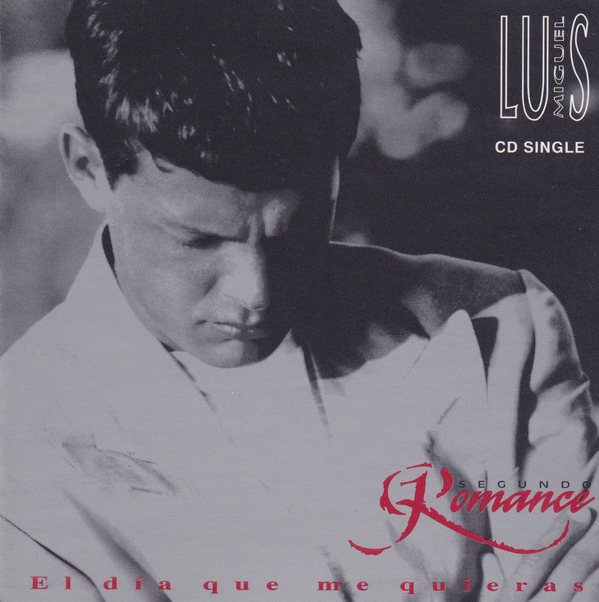
LUIS MIGUEL, “EL DÍA QUE ME QUIERAS”

17th September, 1994


Before you do anything else, you're going to want to click here. That's a link to the original version of this song, recorded in 1935 by tango pioneer, pop singer, and first Latin superstar of the twentieth century, Carlos Gardel. To get the full effect you may wish to read along with the lyrics, which I've translated (very roughly) at the bottom of this post.

Are you back? Okay.

Gardel's song, a self-consciously pastoral fantasia, a movie song (it was written by Gardel and lyricist Alfredo Le Pera for the Argentinean movie of the same name, starring Gardel), and a ballad very much in the international Thirties tradition of sumptuous sentiment married to coolly unemotional performances (compare to Bing Crosby or Dick Powell), is one of the great songs in the Latin Pop tradition, the definitive ballad of the Golden Age of Tango (ca. 1915-1955), the sudden flowering of modernism in Latin American popular culture comparable to the mixture of jazz and Art Deco in America. The tango rhythm here is almost subterranean due to the ballad tempo; only the entrance of the bandoneón in the last few choruses ties it to the traditional tango sound.

By covering this song, and by releasing it as the initial single off his new album Segundo Romance (Second Romance), Luis Miguel is explicitly placing himself as the successor to Gardel's fusion of modernism, sentiment, and iconicity -- Gardel died in a plane crash not long after recording this song, cementing his legendary status. Imagine Michael Jackson topping the charts with an Astaire cover (say "They Can't Take That Away from Me") in 1989, and you might get something of the interplay of reverence, ambition, and sheer inertial popularity at work here.

As the title of the album indicates, this is Miguel's second time laying claim to the tradition of classic Latin Pop (you may recall that the first Romance, a more strictly bolero album, produced "Inolvidable" and "No Sé Tú"), but it was far and away his most successful -- in fact it holds the record for highest-selling Latin album by a male singer of the 1990s. This probably has less to do with his fidelity to tradition than to his own magnetic self; his version of "El Día Que Me Quieras" isn't particularly faithful to Gardel's original in either chord voicing or phrasing (though he does keep the bandoneón, the instrument that sounds like a higher, thinner accordion). He converts it, essentially, into a Luis Miguel song of the 1990s, and if (like me) you have a hopeless passion for the thin crackle and low-frequency orchestras of old 78s, the blown-up keyboards and polished, glistening soup of a production is wince-inducing in comparison to the original.

But the polish and temper of Miguel's own voice cannot be denied; and if he is a worthy successor to Gardel, it is in the impeccability of his phrasing. He too paints on a sweepingly sentimental canvas, but his brushes are dry, and the song, which could easily be a wreck of overemoting in other throats, is instead a monumental sculpture, a nostalgia-free tribute to the Art Deco era in modern materials and to a modern scale. Of course, nothing ages so quickly as modernity.

Those lyrics:


22.11.10

RICARDO MONTANER, “QUISIERA”

3rd September, 1994


In the middle of the most exciting year Latin Pop has had since the chart started (and more wonders to come, or at least I'll think so), it's helpful to be reminded that some things are constant. This will be our last encounter with Ricardo Montaner (barring unexpected comebacks, of course), and he goes out as he came in, with a blustery, rather pompous ballad that gestures towards the dramaturgy of rock but ends only by overstaying its welcome.

"Quisiera" means, roughly, "I would wish" or "I could wish" (the imperfect subjunctive mood isn't available in modern English), and what he wishes is to hide the person addressed away in oblivion ("esconderte en olvido," i.e. to forget her); it's another self-dramatizing portrait of a love affair gone badly, and he claims to suffer from "delirio y mezclade hastío" (madness blended with boredom), for which the only cure is to consign her to the deep past, for centuries and centuries (no really! that's the chorus!) — that, it turns out, is what he would wish.

Well, I can only wish him well in his attempt to forget. His own appearances here have been pretty difficult to remember, so we're even; and besides, we're hurtling forward into fascinating territory, and we don't need undercooked power ballads dragging us down.

8.11.10

PIMPINELA, “CON UN NUDO EN LA GARGANTA”

14th May, 1994


I've been crowing in the past few entries about the modernization, newfound sophistication, and even hipness of Latin Pop in 1994; and right on cue, here come Pimpinela to serve up some good old-fashioned corn.

Pimpinela were (are, even) that most deeply unfashionable of showbiz staples, a brother-sister act. Lucía and Joaquín Galán were from Buenos Aires, had longstanding showbiz connections — Luis Aguilé, a popular singer and composer in the 1950s, got them their start in the early 80s — and sang in an old-fashioned romantic style, the way brother-sister acts always do. Here, with the mandolin-like washes of melody over a one-two saunter, they're recalling classic ranchera styles, but their voices are purest pop — especially Lucía's high, thin dream-pop tone, which I'd like to hear more of in a less restrictive environment.

The song itself is a traditional-sounding (the songwriting credits include both Galáns, so it's not that traditional) lament for lost love: the title translates as "with a lump in my throat," and Lucía sings of how she regrets having said goodbye, while Joaquín swears he never meant to hurt her. It's so traditional, in fact, that this is (as far as I can remember) the first appearance of an accordion — or an accordion-like instrument; the production's so vague and dreamlike, it's hard to tell — in this travelogue. Anyone who's been near a building site in the Southwest knows that the accordion is perhaps the most traditional ranchera instrument there is; it may say something about the powerful gravitational pull of 1980s synthetics that it's taken this long to hear it here.

9.9.10

RICARDO MONTANER, “PIEL ADENTRO”

13th March, 1993


Ricardo Montaner continues his string of polished ballads that are far more erotic than they sound to an Anglophone. "Piel Adentro" means "skin inside" or "skin within" and a Google search turns up, besides this song, sex-and-dating sites.

But for all that, it's still as crashingly romantic as the music sounds. He's looking back on the sex as a metonymy for the relationship, and it apparently wasn't a good one — love turned to dust, he goes sleepwalking through it, the usual surprisingly specific images which are a feature of Latin Pop the way they very much aren't of Anglophone pop of the same breed and vintage.

Montaner has carved out a space for himself as a purveyor of primo ballads here in the early 90s; could he possibly challenge Luis Miguel, unquestionably the reigning champion of Latin ballads since the late 80s, for his throne? On this evidence, probably not; his voice deals capably with the big dramatic chord changes, but it doesn't do more than that. He doesn't have Miguel's gift for nuance or phrasing, and as the song crashes its way to a finish, he starts to sound winded, like a sprinter forced to run a steeplechase.

30.8.10

RICARDO MONTANER, “CASTILLO AZUL”

19th December, 1992


Ricardo Montaner made his first appearance in this travelogue with a power ballad of the Michael Bolton stripe; if this song's glassy, glossy keys and muscial-theater lift recalls instead Peabo Bryson & Regina Belle, that's surely not unintentional. Montaner sang the Peabo part in the Spanish-language version of Aladdin's "A Whole New World," "Un Mundo Ideal" with duet partner Michelle.

But this song sounds more like something out of (or inspired by) 1991's Beauty And The Beast. "Castillo Azul" literally means "blue castle," and the lyrics could be sung by a not-for-kids version of the Beast (or perhaps that other fairy-tale icon, Bluebeard) showing his new bride around the place. Not-for-kids because he goes adult very quickly; halfway through the first verse they're stripping off their clothes and by the lead-in to the chorus he's singing wistfully of "el momento pleno de hacernos sexo, a orillas del mesón." ("The fullness of the time we had sex in every corner of the place.") The imagery, in fact, is gorgeous, even intoxicating; a full translation would be a beautiful sample of erotic poetry, and is beyond my powers.

But of course little of that transcendent rush is conveyed in the music: formally, this is another bland, vacantly crescendoing ballad with almost no compensations for someone who doesn't understand the language. (Almost: the orgasmic rise and subtle funk guitar on the brief middle eight have their low-key pleasures.) And so we close out 1992 on a faintly disappointing note; so far it's the year I've liked the best as a whole — largely if not entirely thanks to Jon Secada — but there's more and better still awaiting us in the future.

26.4.10

RICARDO MONTANER, “LA CIMA DEL CIELO”

27th January, 1990


This sounds so perfectly 1990 to me — those slow-building, gospelly melodies were very much in vogue as the fabulous 1980s prepared for the earnest 90s — that I'm almost tempted to believe that its being The First Number One Of The 1990s is somehow significant. But it's just as much another entry in my theory of ballads belonging to the winter months.

It's also the first time an Argentinean singer has appeared at the top spot so far. (Montaner was born in Argentina but raised and achieved his first success in Venezuela.) Argentina is the richest and most powerful Spanish-speaking South American country, but partly because its cultural ties are closer to Spain than to the rest of Latin America, partly because of the lengthy Peron dictatorship, and partly because of a certain amount of cultural elitism, its pop culture hasn't necessarily been very popular throughout the rest of Latin America.

Montaner began, according to himself, as a black metal singer, but it was a series of baladas románticas that made him famous. You can, if you try very hard, hear a bit of rock vocal stylings here, but it's closer to the theatrical soul stylings of the post-Hair Broadway. Nevertheless it's an assured production, only a step or so removed from the Michael Bolton, Bryan Adams, and Richard Marx songs which were blanketing the English-speaking world at the same time.