Showing posts with label bolero. Show all posts

25.8.25

MANÁ FT. SHAKIRA, “MI VERDAD”

28th Feb, 2015


A pair of Nineties veteran acts joining up for a laid-back swayalong feels like the kind of thing that the streaming-era chart had no room for anymore; and the fact that it only went to #1 for a week in February 2015, one of a series of one-week wonders in late winter sandwiched in between monumental chart runs, seems more a product of chance (or perhaps of Billboard tinkering with its chart calculus) than of true blanket popularity. (On the airplay chart, it managed a whole two weeks at #1.)

Not that I'm complaining! While I've been largely cool on Maná in these pages, I've consistently adored Shakira, and maybe predictably, I find that her sweet-and-sour voice is exactly the ingredient needed to pull Maná out of their latter-day doldrums and sound vividly, achingly sincere, like a sharp, high clarinet cutting through thickets of droning strings.

The lyric is constructed on a dialectic of "mentiras" (lies) and "verdad" (truth) -- the verses list all the falsity and betrayal that exists in the world, from cheating lovers to lying politicians, while the chorus calls the eternal romantic "you" the singer's truth, a refuge from the painful deceptiveness at large in the rest of existence. Although in the video, Shakira caresses a visibly pregnant belly (she gave birth to her second child the month before the single's release), transforming the "you" from romantic to parental love. And in the comments on the video, that seems to be the favorite reading: many family relationships and losses are related there.

The bolero rhythm underlying the verses, and the foursquare rock rhythm of the choruses, have their own implications (the tricksy, scheming Afro-Latin tradition versus the open, honest, white-coded sound?), although Maná are a rock band and believe in rock dynamics above everything. But this is their farewell (as of this writing) to this travelogue, so I can't be sorry that they brought on my favorite Colombian ringer to leave a better taste in my mouth than they might have otherwise.

Airplay Watch:

  • Maná ft. Shakira, "Mi Verdad"
    • Discussed above.

26.8.19

JENNIFER LOPEZ, “QUÉ HICISTE”

5th May, 2007

Wiki | Video

This is only Ms. Lopez' second appearance on this travelogue, and her first appearance by herself -- her debut was eight years ago, in a duet with Marc Anthony, who (as of this #1) she has been married to for three years. And although he doesn't sing on this song, his fingerprints are all over it: the principal melody was, the story goes, given to him in a dream by Rocío Dúrcal (who had only recently died), insisting that it was "for Jennifer." So Anthony, along with a Colombian songwriting husband/wife team he regularly collaborated with, has the writing credit for the song. Which (of course, since I'm writing about it) paid out: a #1 Latin hit, respectable placement throughout the European charts, even Lopez' Spanish-language debut on the Hot 100.

But Lopez is no Dúrcal: she has a dancer's, even an actor's voice, and her singing here is more dramatic (aided of course by tense, massive production) than technically polished. There's nothing wrong with that: in fact it gives her songs something of an everywoman quality, easy to belt along with in the car or in a late-night rage over the fucker who ruined your life. Because it's a kiss-off song, and a really good one, full of righteous fury and reclaimed self-respect, a woman leaving behind a man who destroyed their happiness with uncontrolled anger and words he couldn't take back.

But the lyrics, poetic and specific as they are, are secondary to the production, alternating between quiet, tension-building verses under which plucked guitars and scraping strings burble, and explosive choruses where power chords, rock drums, and swirling strings lend force to Lopez' full-throated denunciations. It's not surprising that the production was handled by Anthony's long-time salsa collaborator Sergio George (or that a salsa remix was made) -- the punchiness and drama of contemporary tropical music underlies the whole thing, even if the tense, sawing rhythms are much more old-world than the liberatory dancefloor beats of salsa.

It's a really good song, one of J. Lo's career highlights, even if its mixture of rock instrumentation and high drama don't quite seem to fit together at a decade's remove. Writing about the mid-to-late 2000s in the late 2010s has been an exercise in trying to see truthfully: it's just far enough away that it feels fundamentally different from the present, but not far enough away for a coherent nostalgia to have accrued around it. Everything still feels awkward and unfinished, like prologue to now; remembering that it felt then like the culmination of history (as is habitual for me with earlier periods) is still work.

15.7.19

ALEJANDRO SANZ FT. SHAKIRA, “TE LO AGRADEZCO, PERO NO”

10th March, 2007

Wiki | Video

The third in a trilogy of songs that have been winding through the #1 chart for almost two years, at least in terms of how I've received them. The Shakira/Alejandro Sanz duet "La Tortura", in the summer of 2005, was the longest-reigning #1 song on the Hot Latin chart at the time that I began this blog in 2010, a crowning glory of mid-2000s Latin pop. Then Sanz's solo hit "A La Primera Persona" was only on top for a week in November 2006,  a compact illustration of the difference between pop thrillpower and tasteful male auteurism. Now "Te Lo Agradezco, Pero No," its video a direct sequel to that of "A La Primera Persona," only reigns for only one week: Sanz is still very much the auteur here, Shakira playing a duet partner rather than expressing her own thoughts in her own vivid language. But her very presence lends more color and drama to the song: the music moves to a danceable rhythm (and Sanz himself enters into some choreography in the video, a first for him, apparently at Shakira's insistence), and uses a sturdy Afro-Latin chassis even though the body is auteurist European pop.

And if "La Tortura" was about a woman's rejecting a man's take-me-back whinging, and "A La Primera Persona" was about a man pitying himself over lost love, "Te Lo Agradezco, Pero No" forms a sort of resolution: both man and woman reject the other's overtures at reconciliation, because they are adults and can recognize the toxicity of their past entanglements: they've both hurt the other, and they're setting each other free. Sure, there's still feelings, sure, they will probably return in the future, but they don't belong to each other. All of this, however, is inference and implication: Sanz' lyrics are typically telegraphic and a bit gnomic, and rhythm and sound matter more than laying out a coherent narrative. Multiple readings can reside in any good pop song, and this is a very good pop song.

It begins as a maundering bolero, with acoustic guitar and swaying conga rhythms giving propulsion to Sanz's throaty murmurs, but as the song builds, more and more elements are introduced, including subtle electronic percussion, so that by the time Shakira enters, whispering in unison with Sanz, it's developed into a catalan rumba, the combination of flamenco passion and Afro-Cuban rhythm that served as a particularly Spanish response to the modernism of Anglophone folkies like Bob Dylan. (Sanz works very much in the lineage of Dylan; and of Gato Pérez). And then, after the second chorus, a Memphis soul horn chart breaks out, turning the song into full-out Latin jazz, which Sanz's phrasing and harmonic leaps have been anticipating all along. The chorus is pure 70s r&b, and as more and more voices get added to it it takes the pull of gospel; and when Sanz breaks out into a half-rapped improvised montuno it's a gesture toward both salsa and r&b traditions.

It's notable that none of the traditions Sanz is folding in are particularly new: genre as a capacious grab-bag of historical authenticities is a familiar mode to many postmodern artists of his generation, among whom I'd include people as different as Peter Gabriel, David Byrne, Juan Luis Guerra, or Manu Chao. The gestalt is the point, much more than recreating any one tradition in particular. Shakira, too, has worked in this synthesizing manner (see "Suerte"), and if the traditions she's engaging with here feel more particular to Sanz than to her (her vocal timbre is much more muezzin than gitano), that seems to be exactly what she wanted when she approached Sanz with the desire to be on the other side of the "ft." this time.

1.10.18

OBIE BERMÚDEZ, “TODO EL AÑO”

8th January, 2005

Wiki | Video

The first new number one of 2005 is also (probably) the last time we'll be seeing Obie Bermúdez on this travelogue. It's also his best song, record, and performance of the three we've heard: a year on from his breakthrough, his voice is huskier and less whiney, which exactly suits the low-key, largely acoustic mood of the song. It's the kind of song which an Anglophone contemporary like Gavin DeGraw might have blanketed malls with, but because Latin pop is so musically diverse (and because Sr. Bermúdez as a pinup had only very limited appeal) it would be quickly left behind in the rush to elevate more dazzling songs and sexier stars.

But while it's here, it's a very good rock ballad with slow, barely discernible island rhythms. The almost inaudible maraca insisting on a dotted triplet on the second verse while the drums plod in straight rock time is a vague gesture toward Cuban bolero, or even Puerto Rican plena. It's soon overwhelmed by the galumphing rock sheen, of course, but its memory and Obie's faithfulness to a soulfully syncopated rhythm makes the song engaging where a smoother, more straightforward singer would make it soporific.

2005 is an unusual year in the middle of the 2000s, a sort of preview of what the chart will be like under streaming: so dominated by a few massive hits that there will only be nine #1s all year, the record low since 1991's eight. That record will be broken in a decade's time, but the modern period of Latin Pop really starts this year. Stay tuned.

17.9.18

ALEJANDRO FERNÁNDEZ, “ME DEDIQUÉ A PERDERTE”

23rd October, 2004

Wiki | Video

Throughout the last decade of this travelogue, whenever Alejandro Fernández has shown up it's been cause for celebration. One of the most tasteful and careful musicians of his generation of Spanish-language pop stars, he's been a better singer than Enrique Iglesias, a more thoughtful selector of material than Ricky Martin, and less interested in chasing trends than Marc Anthony.

And he's paid the relative penalty for it; fewer #1s, of shorter duration, than his peers, and no crossover hits. He hasn't sung in English, remaining a faithfully Mexican star, and he has mostly stayed out of the Anglophone media circus: the Hispanophone media circus is giddy enough on its own.

But his 2004 album A Corazón Abierto (with open heart) signals a change. The classy suits and charro cosplay of his twenties are gone: and the on the cover of the single for "Me Dediqué a Perderte" (I dedicated myself to losing you) he's in a t-shirt and hippie wristbands, like he's trying to be one of those younger, more rock-oriented stars, a Luis Fonsi or a Juanes.

The song is similarly contemporary: although there's still a bolero inflection to the percussion, it's drowned out by the studio drum kit playing straightforward ballad rock. The song was written by Leonel García of Sin Bandera, and that band's generic music-from-nowhere sound has overwhelmed Fernández' classy traditionalism. But then, classy contemporalism gets you hits. For a season.

Fernández the singer is still a marvel: nuanced and emotive, he savors every syllable in his burnished throat like the singer Enrique Iglesias wishes he was. But the song just sits there instead of taking flight: the string arrangements which have so often been a highlight of his appearances here just flutter uselessly instead of providing dramatic contrast.

It's the sound of a singer aging into a comfortable stasis. From here on out, it's increasingly unlikely that Alejandro Fernández will challenge himself or his audience; like Luis Miguel, his place as a permanent fixture of Mexican culture is secure, and he can coast. The kids are coming up from behind.

19.3.18

MARCO ANTONIO SOLÍS, “TU AMOR O TU DESPRECIO”

12th July, 2003

Wiki | Video

My moderated take on Maná's music last week is the product of having worked on this blog for eight years: when I started it, I was certain I would adore Maná as a breath of fresh air. But my esteem for straight-up rock has diminished, while my esteem for the romantic Mexican balladry Maná was always a reaction to has only grown. I've publicly despised (or, more kindly, didn't get) a lot of Marco Antonio Solís's work over the years, but here's where I come around fully on the man.

Possibly it's just the production, thick but detailed, with tenderly atmospheric horn charts and swooping strings, a  rhythm carried by timbales and bajo sexto, that generates this response; the aging classicist in me appreciates how well this follows the template of the Golden Age of Mexican song. Solís's thin voice isn't very like the burnished flexibility of Jorge Negrete's or Pedro Infante's, but his shift into a fuller-throated register for the chorus "Tal vez es un error hoy de mi parte..." (Perhaps it's a mistake on my part) is more than adequate.

"Tu Amor o du Desprecio" (Your Love or Your Contempt) takes a relatively unusual theme in the love-song genre: it's a breakup song, but the singer is hesitant throughout to commit to actually saying so, aware of how much pain -- and how much power to inflict pain -- it will create. The final line, "I will have to take either your love or your contempt," is a remarkably clear-eyed and adult summation, refusing either self-martyrdom or self-pity.

It does run on a touch too long: five minutes is an eternity when you've sung the entire song in two. But I can forgive a lot when it sounds this good.

12.3.18

MANÁ, “MARIPOSA TRAICIONERA”

5th July, 2003

Wiki | Video

I've been using the "rock en español" tag quite liberally since starting this blog eight years ago (real time) and fourteen years ago (chart time), but this may be the first time it actually applies, at least to the degree that "rock en español" was ever an organic musical movement and not just a marketing campaign. (And to the degree that, under capitalism, there is a difference.)

In the 1980s, "Rock en Tu Idioma" (rock in your language) was a publicity campaign started by a Mexican subsidiary of an international (originally German) record company to sell the middle-class youth of Latin America on local bands playing in styles which had originated in the US and Great Britain between 1956 and 1980, as a complement to rather than as a replacement for the English-language originals; what "rock en tu idioma" was meant as a replacement for was local (and often heavily racialized) styles of music which working-class audiences played and enjoyed, and which nationalist elites, after enough time had passed for nostalgia to do its work, always appropriated for propaganda purposes. What young Mexican Maná fans in the early 90s were rejecting was not the imperialist ubiquity of U2 or Pearl Jam, who they also loved, but the supposed provincialism and sentimentality of Los Bukis or Juan Gabriel (and never mind the traditional bolero, trova, and ranchera music which would have been the Mexican equivalent of jazz song).

When the English-language music press caught on to the Spanish-language rock scene in the 90s as part of their dilettantish interest in "world music," they used "rock en español" as a replacement for "rock in tu idioma," boosting acts like Maná and Café Tacvba whose massive popularity throughout  Latin America was scarcely increased by a handful of semi-adventurous English-language fans. My introduction to Maná was in this English-language press (my younger siblings, who paid closer attention to local popular culture when we lived in Guatemala in the early 90s, knew them already), but it wasn't until I began to really dig into Latin music in earnest in the late 2000s that I listened to them with any attention.

And? They're fine. The trouble with "rock in tu idioma" was the same trouble that rock in general was having in the 1980s and 90s: genre-requisite signifiers of rebellion and Dionysian menace had long since turned itself into the complacent, self-perpetuating mainstream, which by its nature shuts out the poor and otherized, so that truly countercultural rebellion and visions of sexual freedom were taking place elsewhere: in the underground, in hip-hop, dance music, and (in Latin America) the electronic blends of Jamaican and Latin music which would eventually coalesce into reggaetón. (Which in 2018 has become its own hollow, self-perpetuating mainstream, but one thing at a time.)

This is a long way to go without talking about the actual song. Which is unrepresentative of Maná's dully earnest hard-rock catalog, but perfectly representative of where the top of the Hot Latin chart was at in the early 2000s: "Mariposa Traicionera" (Betraying Butterfly) is an old-fashioned swaying bolero played by a rock band with high-gloss studio accompaniment, not wholly unlike recent entries from Gloria Estefan, Alejandro Fernández, or Charlie Zaa. The main "rock" signifiers are singer Fher's hoarse tones and guitarist Sergio Vallín's tasteful guitar runs, which also fit into the Cuban-Mexican tradition the whole song is cast in. The final refrain, with its repeated "ay ay ay ay ay dolor," is even specifically Mexican, a nineteenth-century corrido trope which the trova (troubadour) tradition kept alive in the twentieth century.

Our first encounter with Maná is late enough in their career trajectory that Revolución de Amor was heralded as a masterful self-reinvention; if they're comparable to U2, it's their Achtung Baby. It won't be the last time we see them, but the genius of the charts, the way they flatten out all subcultural distinctions and actually lived patterns into sheer unmeaning numbers, is that they sound here not as a revelation but as continuity. 

30.10.17

CHARLIE ZAA, “FLOR SIN RETOÑO”

23rd February, 2002

Wiki | Video

Two years into the new millennium, Latin music is less regionally-oriented than ever. Charlie Zaa, born Carlos Alberto Sánchez, is Colombian, and grew up singing in his father's local orchestra, which played cosmopolitan Latin dance music for hotel crowds: which meant, in the 70s and 80s, salsa and merengue and big-band cumbia. When Zaa began his own career in 1990, it was with a series of salsa bands: he went solo in 1996, with a smash album covering midcentury Mexican (and pan-Latin) boleros and waltzes. Following the money, he continued the formula for the next half-decade, hitching his wagon to the Estefans in 2001, and scored his first (and to date only) number one hit with the standard "Flor Sin Retoño" (Flower Without Bloom), written by the great Mexican composer Rubén Fuentes and made famous by legendary crooner Pedro Infante in 1954.

It's one of the classic boleros, an extended floral metaphor for the damage men do to women (legible as either the traditional concern over "deflowering" or a more modern understanding of abuse), which sticks so tightly to the metaphor that it becomes a fable. One that (of course) prioritizes the man's feelings; but in the closed systems of patriarchy, truth often has to be smuggled in through metaphor.

In 2002, Zaa was not yet thirty, and his youthful good looks are made much of in the video, which does its best to corrupt the song's central metaphor by turning the woman/flower a sorceress who has bewitched him -- but the lame CGI visuals are nothing compared to the sexy, detailed shake and sway of the music. Infante's production in '54 was no slouch, but Zaa's transcontinental production adds Cuban montuno punchiness to the bolero rhythm, as well as muted mariachi horns, romantic strings, and his own honeyed, close-miked voice to create a bigger-than-life sound, not unlike Gloria Estefan's excursions in to Cuban musical history, that I want to call nostalgic immediacy.

Like Luis Miguel, he's plowing a limited furrow; but unlike him (and like Alejandro Fernández or Carlos Vives), he lets the dynamism and attitude of the postmodern present inhabit the spirit of the classicist past. If we're not to see him again, I'm glad to have met him here.

23.10.17

LUIS MIGUEL, “CÓMO DUELE”

2nd February, 2002

Wiki | Video

Luis Miguel's fourth album of bolero and other romantic Latin standards in a decade, especially considering everything else that has changed since 1991, suggests an exhaustion of ideas, of ambition, even of desire. He produced it by himself, apparently unwilling to wait for his usual collaborators Armando Manzanero and Bebu Silvetti, and reviews at the time were unkind, accusing him of prioritizing his bank account over any artistic growth or integrity.

They have a point. "Cómo Duele" was one of two originals on the album, co-written by Manzanero for Miguel, but its pompous strings from the Royal Philharmonic and light disco guitars never approach the painstakingly gorgeous production from the early-90s albums Romance and Segundo Romance. And Miguel, though his voice remains a burnished instrument, sounds as though he's sleepwalking through the song, gesturing towards drama but never embodying it.

He was still on top of the world: the tour broke box-office records, even while the album itself only sold middling (for a Luis Miguel album). He won a Latin Grammy for it, the usual reward for making a lot of people a lot of money. But he is more definitely than ever a relic, left in a nostalgic, going-through-the-motions past while the Latin pop produced by his peers and his juniors rapidly transforms and evolves around him.

16.10.17

ALEJANDRO FERNÁNDEZ, “TANTITA PENA”

10th November, 2001

Wiki | Video

The periodic interruptions of Alejandro Fernández into this travelogue have quietly become one of my favorite features of the journey since the late 90s: he is so rarely chasing new trends or crossover success, and his taste in production and songs tends to be so exquisite, that he can come as something of a relief from the more bombastic or kitschy elements that regularly wander into #1.

"Tantita Pena" (so little pity) revives another classic sound: but where Fernández had largely explored the intersection of ranchera and slow-moving, moody bolero before, at least as far as the #1 spot was concerned, he now combines mariachi structure and flamenco rhythms, with a montuno breakdown toward the end, combining Mexican, Andalusian, and Cuban traditions into a thrilling, explosive dance song too rhythmically complex for most gringos to bop to.

The lyrics are as old-fashioned but modernized as the music: the theme is the ancient one of the belle dame sans merci, but Fernández is no blameless, suffering victim: if she abandoned him and left him to die "sin tantita pena" (without a bit of pity), now he hopes to see her weep over the same sorrow, when he too will be sin tantita pena. The video almost lives up to the song: a surreal, Felliniesque celebration of traditional ranchera fashion, telenovela aesthetics, transatlantic Hispanic dance, and Mexican folklore, it's a monument to Fernández' ability to synthesize past and present, tradition and novelty, his intelligent singing, and his glamorous beauty.

Enrique Iglesias will continue to get the glory, but Alejandro Fernández will remain the thinking pop fan's second-generation Hispanophone star.

6.3.17

RICARDO ARJONA, “CUÁNDO”

7th October, 2000


We met Guatemalan singer-songwriter Ricardo Arjona earlier in 2000 with a beautiful modern-rock (modern for the 90s) ballad. But it was from his last album, and his new album was Galería Caribe, or Caribbean Gallery, a showcase of his versatility with the multi-colored musics of the tropical islands. Or, perhaps, his lack of it.

"Cuándo" (When), for example, is nominally a bolero, the swaying Cuban lilt that became the glory of midcentury Mexican popular song; but while the congas tap out a swaying rhythm, it's an awfully stiff one, practically 4/4, an unadventurousness which clarifies when electric guitars start revving up in the middle eight, and the song reveals itself as just another power ballad wearing tropical-Caribbean clothes. The muted trumpet, the acoustic guitar runs, the swooning strings, and the conga percussion is all beautifully performed and expertly knit together, but underneath it all is a guy in a flannel shirt whose musical instincts never stray far from the repetitive blues-based structures of classic rock.

With that disappointment, it's a surprise that "Cuándo" is still as good as it is, not just as a piece of production, but as a song. Ricardo Arjona can write a smart lyric, as we knew as far back as 1994, and "Cuándo" is a major performance in lyric-writing. The opening lines, "¿Cuando fué la última vez que viste las estrellas con los ojos cerrados / y te aferraste como un náufrago a la orilla de la espalda de alguién?" (When was the last time you saw the stars with your eyes closed / and clung like a castaway to the shore of someone's shoulder) present much more thoroughgoingly poetic imagery than Anglophone pop usually has room for, even beyond the obvious sexual allusions.

The rest of the song turns into rather a scorned-lover diatribe, but Arjona's closer to Dylan than to Morrissette in that category, and if it weren't for his plodding rhythm and rather anonymous voice, "Cuándo" could be a great, rather than just a good, song.

24.10.16

GILBERTO SANTA ROSA, “QUE ALGUIEN ME DIGA”

11th March, 2000


The iceberg of Latin Pop, of which the #1s discussed in this travelogue represent not even the above-water tip, but rather only the layer of molecules exposed to the air, has contained far more salsa than we've been allowed to glimpse, to the extent that about half of everything on this blog tagged as "salsa" isn't. And neither is this, really, except that Gilberto Santa Rosa is a salsa singer, and so everything he sings is salsa. Kind of.

He's been knocking around Puerto Rican salsa since the mid-70s, he exploded to worldwide fame with a legendary 1990 Carnegie Hall concert (his four-minute improvised soneo in "Perdóname" became so frequently played that he was forced to to memorize it for future concerts), and here on the cusp of the 2000s he's settled into an elder-statesman role. "Que Alguien me Diga" is a romantic song written by Panamanian salsero Omar Alfanno (remember that name) to the accompaniment of a classy string section and glassy keyboards, which only breaks into a gently percussive sway on the chorus rather than breaking into a full-bodied salsa montuno. His voice is undoubtedly a wonderful instrument, soulful and flexible, but like an Olympic athlete playing with kids he's using less than half of its capabilities.

It's probably more accurate to class the song as a bolero rather than salsa, despite the light piano guajeos on the chorus, which isn't a bad thing -- some of my all-time favorite songs are boleros -- except that it's unfortunate that this looks likely to be the sole representative of Santa Rosa's talent in these pages. Swept up in the current of a much bigger hit (stay tuned), he's largely only present as an adjunct, rather than in his own right. But do listen to "Perdóname."

8.4.13

CHAYANNE, "DEJARÍA TODO"

12th December, 1998


It's been six years since Puerto Rican pop star Chayanne has bobbed to the surface on these top-of-the-chart waters; although he's been working steadily in the meantime and been relatively successful at it, this still marks something of a comeback for him. Written by Estéfano, a prolific songwriter and producer from Colombia whose previous success stories had  included Jon Secada's debut album and Gloria Estefan's Mi Tierra, "Dejaría Todo" continues Chayanne's success with midtempo ballads. This time, thanks to Marcello Azevedo's nylon-stringed guitar, it has what you might call a stereotypically Latin flavor, a vaguely bolero sway, though not so pronounced that the barreling power-ballad chorus gets tripped up in any kind of polyrhythmic syncopation.

It's a "she's leaving me, my world is ending" song — more or less literally — and if the emotional hyperbole of the lyrics doesn't quite match up with the bland, adult-contemporary longeurs of the production, that's nothing new. Chayanne's voice isn't powerful, but it's pretty and well-suited to the aching romanticisms he's called upon to emote. (Enrique Iglesias, for example, would make an unlistenable fist of what Chayanne relaxes into.) It goes on for too long, as the chorus repeats and repeats, but it remains listenable throughout, Estéfano's production magic keeping each instrumental injection just this side of stultifying. The choral effect on the last several iterations of the chorus is both gilding this particular lily and getting to be a bit tiresome on this travelogue — how many faux-gospel choruses does that make within the past year? — but I'm surprised to discover that I have some affection for Chayanne.

Which is good, because he'll be back.

15.8.12

ALEJANDRO FERNÁNDEZ, “YO NACÍ PARA AMARTE”

18th July, 1998


Three singles from the same album, three number-one hits — this is Enrique Iglesias levels of success, and it's worth taking a moment to step back a bit from the churn of the chart and survey the landscape. The Hot Latin #1 spot has had its dominant artists, of course — Luis Miguel is not yet thirty in 1998, and hardly to be counted out — but the totalizing effect that the new generation (Iglesias, Fernández, and soon enough Marc Anthony, Ricky Martin, and one still unheard voice) is having is unprecedented. From the perspective of 2012, it looks very much like a bubble, like so much else in the late 90s, from Bill Clinton's Pax Americana to the first dotcom rush to unprecedented profits from sales of recorded music. But in 1998, 9/11, Web 2.0, and the cratering of the music industry are still far in the future. So is the splintering of the Latin market, which will make the coming decade fascinating in its novelty, diversity, and unpredictability; but here at the tail end of the twentieth century, the illusion of consensus reigns supreme.

"Yo Nací Para Amarte" does nothing to break the illusion. Alejandro Fernández, with the support of the Estefan machine, has been established as a major young heartthrob, and this third single — written, once more, by Kike Santander — is another swooning ballad in a classicist mode. A bolero, with sensitive finger-picked guitar leads and gently swaying percussion, it leans deliciously florid and is only kept in check by the extraordinary sensitivity of Fernández' vocal performance; listen to the infinitesimal pauses and controlled quaver on the final chorus, and you can hear why Luis Miguel, the reining king of vocal technique, may have cause to worry.

The floridity, then, is all in the lyrics — and they're extremely florid, as you might guess from the title ("I was born to love you"). A declaration of self-immolating desire as hyperbolic and quasi-religious as anything found in medieval courtly-love poetry, it's hard to take seriously as a statement made from one adult to another. From a literary teenager to what he imagines the girl he has a crush on to be, however — but that way lies unprofitable autobiography. Thank God for Fernández' coolly controlled interpretation; the slight irony and distance he provides is the only thing keeping the song upright.

25.6.12

ALEJANDRO FERNÁNDEZ, “NO SÉ OLVIDAR”

14th March, 1998


Bolero, which originated (as a romantic music, anyway; the rhythm is originally Cuban) in the low-life cantina scene of Mexico City in the 20s and 30s, grew into a lot of different permutations as it became the standard pop language of Latin America from the 40s through the 60s; bolero costero (coastal bolero), bolero habanero (Havana bolero, fused with son, rumba, or U.S. rhythm and blues), bolero ranchero. Ranchero stars like Pedro Infante and Jorge Negrete — icons of the Golden Age of Mexican Cinema in the 40s 50s — sang boleros too, but with a ranchero, or pop-country, flavor.

All of that (limited understanding of) history is what comes to mind on the third single from Alejandro Fernández' Me Estoy Enamorado. The rhythm is definitely a bolero, but the horns erupt into the mariachi cadenzas typical of ranchero, and the sweeping strings belong to both traditions. As a committed fan of even the most banal musical cross-breeding, I was going to like this anyway; but Fernández' performance is exceptional. Big-voiced (naturally), but with uncommon sensitivity around the edges of the floridly sustained notes on the chorus. He's not quite at Luis Miguel's level, but (at least for the moment) he's not a bad replacement.

The song itself lets him down a little. Sure, it's got the appropriate sweep and holds together well melodically (you wouldn't expect anything else from Kike Santander), but the lyrics aren't top-shelf. "No sé olvidar como  lo hiciste tú" (I don't know how to forget the way you did it) isn't eternal love — or rather heartbreak — poetry, though the following image ("tú has quedado clavado en mi pecho como si fuera ayer," you are still stuck in my chest as if it were yesterday) is at least memorable. It hardly matters, of course, with that swaying rhythm and those swirling strings and the plaintive guitar lines and those pealing horns and above all Fernández' masterful voice ... but third singles are third singles for a reason.

8.6.12

ALEJANDRO FERNÁNDEZ & GLORIA ESTEFAN, “EN EL JARDÍN”

27th December, 1997


Our last duet was between aging superstars Juan Gabriel and Rocío Dúrcal, who were reviving the great 19th-century tradition of the son ranchero. Alejandro Fernández is quite literally of the next generation (his father was Dúrcal's exact contemporary), and Gloria Estefan, though more than ten years his senior, still plays young in the right light; the throwback tradition preserved here is the bolero of the 40s and 50s -- and Cuban bolero rather than the more noir-y Mexican version. Fernández had relied on the Estefan machine to get hits, and they came as a package; songwriter Kike Santander, producer Emilio Estefan, and La Gloria, now on her eighth appearance in these pages. (This, incidentally, now makes her the female Latin artist with the most number ones as of 1997, beating Ana Gabriel's record of seven.)

"En El Jardín" (in the garden) is a sweet song, with lovely string-ensemble decoration, and tasteful accordion and trumpet solos punctuating the proceedings. It's a love song, of course, and for once an uncomplicated one without recriminations or self-aggrandizement: things were bad, nothing gave me lasting pleasure, everything was a disappointment... and then there was You.

The transformative power of love is a perfectly ordinary subject for song, and Santander's lyrics are only notable for keeping a pretty tight leash on the central metaphor of the "jardín de mis amores" (the garden of my love), which had withered, but flourishes now under the new regime. Fernández and Estefan sell it well, particularly Fernández, whose fine voice and an excellent command of phrasing would be a pleasure in any context, but it does drag a bit, particularly when they restate the second verse and full chorus after the trumpet solo; a smart program director would no doubt have long since faded it out.

Where Gabriel and Dúrcal were presenting (even if unwittingly) something of a swan song, Fernández is just declaring his arrival, and Estefan establishing herself as the dominant female voice in the field. They respect the conventions -- but with this song, 1997 is over, and things are going to start to change rapidly.

1.6.12

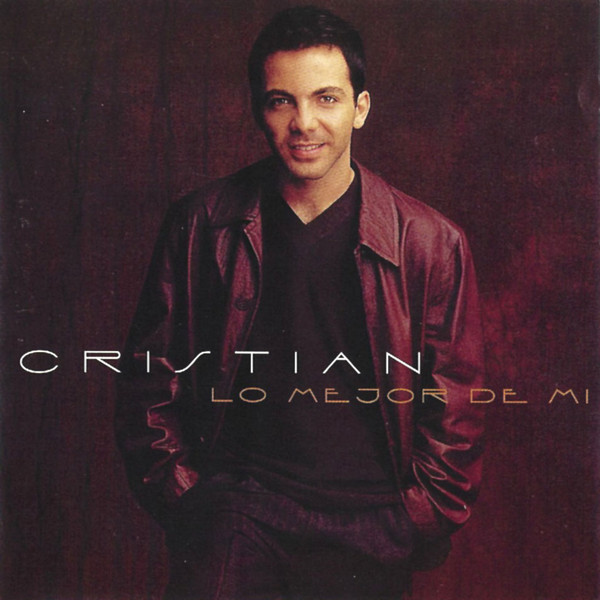
CRISTIAN CASTRO, “LO MEJOR DE MÍ”

22nd November, 1997


As regular readers of this travelogue are aware, I'm fairly skeptical of ballads, demanding to be impressed by great writing, great singing, or great arranging before letting any low-bpm romanticism past my rock-reared defences. So I was already listening to this with one eyebrow raised, as it were, from the very first notes.

And?

It's not bad! Castro's found his own rather fine voice -- no longer shamelessly aping Luis Miguel, he's found his own tricks of intimacy -- and it's tastefully-arranged, with lovely acoustic guitar runs and actual piano instead of electric approximations, and a slow saunter of a bolero rhythm underpinning the whole thing. If it's not lyrically a knockout, well, it's a conventional romántico ballad. "Lo Mejor de Mí" means "the best of me," and the chorus is a complaint that he's given her his best, but it's not enough, she keeps hurting him and he doesn't deserve it.

But then I clicked over to Wikipedia to check up on any facts I needed to know, and saw that it was a cover of Rey Ruiz's 1991 original. And, well, I'm sorry, Cristian, but a danceable salsa ballad is always going to kick a self-important dirgey ballad all to hell. I know I'm something of a hypocrite here, because I love nothing more than a good wallow when I'm romantically rejected, but Ruiz's version, in which it can never get that bad as long as there's dancing and buddies you can do a call-and-response with, is infinitely more attractive to listen to.

29.5.12

ALEJANDRO FERNÁNDEZ, “SI TÚ SUPIERAS”

18th October, 1997


As if to prove that Enrique Iglesias isn't the only son of a famous Latin singer of the 70s and 80s who can command attention, respect, and screaming devotion, here's another extremely recognizable last name. Although we did, if briefly, meet Julio Iglesias early on in this chart voyage, we never directly encountered Vicente Fernández. This is more or less an effect of when the chart began; if it had been running in the 70s and early 80s, he would have waged serious siege to Iglesias' domination. Fernández pére was (and still is) the greatest ranchera singer of his generation and arguably of all time, comparable perhaps to George Jones' position in country music, and if his music didn't always have the transnational appeal of Julio Iglesias pére's, the devotion of his Mexican and Mexican-American fanbase was, and remains, a force to be reckoned with.

Fernández fils began his career following in his father's footsteps, with ranchera and mariachi albums in the early 90s, and had moderate-to-high levels of success. But in 1997 -- and I can't imagine he didn't have one shrewd eye on the stunning success of baby-faced Iglesias fils -- he joined up with Emilio Estefan and Kike Santander, the twin forces behind the throne de la Gloria, and recorded an album of modern bolero, not unlike what Luis Miguel has been doing, but more dynamically arranged. If he was attempting to challenge Enrique for top-of-the-chart supremacy, it worked: "Si Tú Supieras" ("if you knew") was the biggest Latin hit of the second half of 1997, with Fernández' strongest advantage over Iglesias -- his polished, resonant voice -- front and center.

The song itself is only so-so; a languid bolero with flamenco touches on the guitar, it's a ballad of romantic longing, as the title suggests. The most remarkable thing about it is the chorus, in which he expresses a desire "para sembrar mil rosas nuevas en tu vientre" ("to plant a thousand new roses in your womb"), an arresting image that (though I believe it's a spin on an existing Spanish idiom) has become something of a touchstone for online Hispanophone flirtation. It's a strong production, as you would expect from the Estefan machine, and if Fernández still sounds a little formal, a country Mexican singer feeling stiff in these city Miami duds, he'll doubtless grow into them.

31.1.12

LUIS MIGUEL, “POR DEBAJO DE LA MESA”

6th September, 1997


Romances was Luis Miguel's third album of classic boleros and love songs from the rich history of twentieth-century Latin music. As Rod Stewart would find a decade later, it was almost impossible not to keep indulging his audience's nostalgic streak; the records sold too well.

Even the fact that "Por Debajo de la Mesa" (underneath the table) isn't a classic, but a new song written by Miguel's long-time producer for the Romance series (Armando Manzanero, himself a classic song composer of the 60s, 70s and 80s) speaks to the exhaustion that's begun to set in, not only with the series, but with Miguel's own pop career. Only twenty-seven at the time of release, he's already accomplished more than he could have dreamed; and the kids are coming up from behind. Miguel's standard of four hits a year has been slipping for a while, and will only slip away in the years to come. You can build quite a nice career on nostalgia, as thousands of aging entertainers have found; but at least in the modern world, you can't be a pop star too.

"Por Debajo de la Mesa" is a love song — underneath the table he caresses her knee, and then spends the rest of the song wondering what will happen next. Will she accept his advances, will she awaken the fire in his blood? He can't live without her, etc. It's a professional song, professionally arranged, but while Miguel sings it with all the tenderness at his command, he can't make it into a timeless work of beauty. It's filler — gorgeous filler, but filler. And the kids are coming up from behind.

16.9.11

MARCO ANTONIO SOLÍS, “ASÍ COMO TE CONOCÍ”

11th January, 1997


We're deep into that odd stretch of the Hot Latin chart where the top spot alternates between Marco Antonio Solís and Enrique Iglesias with no intermission, and if you're getting sick of it I can't blame you. But skipping irritatedly over Solís' third number one in a row over the same album would be a mistake: it's the best yet.

No doubt I've mostly come to this conclusion because I'm a sucker for Farfisa organs, and the opening riff and later solo are different enough from the usual romántico instrumentation that it caught my ear; but I also appreciate the old-fashioned bolero rhythm and construction, the tasty nylon-stringed guitar playing (sounding like current pop-bachata a decade early), and Solís' carefully-constructed, grown-up lyric. "Así Como Te Conocí" means, roughly, "The way I came to know you," and he draws a portrait that manages to be both clear-eyed and romantic about the end of a relationship. Though he falters into romántico conventionality ("sé que solo fui tu pasatiempo" / "I know I was only your pasttime"), it's mostly as assured a lyric as you might expect from the most acclaimed Latin songwriter of the 90s.