Showing posts with label traditional pop. Show all posts

25.10.11

GLORIA ESTEFAN, “NO PRETENDO”

2nd August, 1997


Probably the most telling indication of my taste-slash-white-boy-assumptions-about-"real"-Latin-music is the reaction I'm having to this run of songs compared to the run that immediately preceded it. Enrique Iglesias and Marco Antonio Solís, much as I've liked individual songs of theirs, are wearying in romántico ballad after romántico ballad slicked up with mid-90s adult-contemporary pop production. The ranchero classicism of Juan Gabriel/Rocío Dúrcal and the countryfied corridos of Los Tigres del Norte, leaning as they did on traditional Mexican sounds, the Latin American version of "roots" music like the blues, country and gospel, were much more agreeable to my classicist's ears. Which may be indication of an "authenticity"-driven double standard applied to Latin music — after all, in Anglophone music of the period, I like the Cardigans way more than, say, Keb' Mo' — or maybe it's just a numbers game. If it were one or two Enriques to every six or seven Tigres, I might be feeling the exact opposite.

I bring all this up because this is the third Latin-traditionalist song in a row that I'm really loving; though the traditionalism here isn't Mexican but Cuban, even Spanish (the flowing flamenco-like guitar lines), and I think I even hear Peruvian huayño (cf. "El Condor Pasa") in the shuffling rhythm. But I'm no expert, as the musicologists falling over themselves laughing at my disorderly tags can attest. And faithful traditionalism would surely be pointless without Estefan's effortless melodicism and Kike Santander's classic songwriting.

"No Pretendo" can be translated several different ways, from the obvious "I don't pretend" to "I'm not trying" to "I don't mean" — either way, the phrase ends most frequently with "ser tu dueña" (be your lady, in the aristocratic as well as the lover sense) and "hacerte mío" (make you mine), and the repeated disclaimers have the effect of enforcing humility: after saying at great length what she doesn't mean to be, when she says what she does want to be it's "el mano que se llene de quebranto, ser un poco el remanso donde muere el desengaño" (the hand filled with broken dreams, a bit of an oasis where disappointments die).

This is practically Victorian — the "ministering angel thou" version of womanhood, rejecting any stronger moral or emotional hold on her man — but the complexity and the sheer poetry of the full lyric make it go down easier, as does Estefan's eternally warm voice, pitched at just the right level of desperation to make the sentiment believable. And listen to the guitars: they're letting us know it's tragic, all right.

3.1.11

SELENA, “TÚ, SÓLO TÚ”

22nd July, 1995


That's all there is; there isn't any more.

This is our farewell to Selena, just over a year since we first properly said hello to her. We're gliding inevitably on to the horizon, and she must remain behind. If this hurts more than any other voice which has gradually faded from these pages — we've seen the last of Ana Gabriel, of Yuri, of Jon Secada, to name just three who have given us pleasure over the years — it's because Selena held more than just the promise of future musical success in her voice, in her beauty, in her ambition. She could have been so much more. She could have beaten back the inequalities of race and language, bridged the gap between Hot Latin Tracks and the Hot 100, belonged not just to a single region, not just to a single language, but to the world.

And in a way, she did, at least briefly. Her death made her more famous than her life to date had done; and Dreaming Of You, the somewhat motley collection of tracks she had been working on in various studios at the time of her death, rushed out to assuage the grief, was her biggest-selling album ever. "Tú, Sólo Tú" was the second single from that record; the first, and the one song you probably know by her, "I Could Fall In Love," was the biggest Latin song to hit the Hot 100 since "La Bamba" back in 1987. It peaked at #8 there, and became something of a generational classic, especially in the urban US. It also raced up the Hot Latin chart, of course, reaching #2; only the simultaneous #1 of "Tú, Sólo Tú" kept it from being included in this travelogue.

But "I Could Fall In Love" was an R&B ballad, perfect for teary memorializing; "Tú, Sólo Tú" is a mariachi waltz, so perfect a companion piece to "El Palo" that this period of our travelogue is starting to look less like a generational shift in listening patterns and more like black magic. But it's not just a soundalike throwback; "Tú, Sólo Tú" is a genuine classic, written by the great ranchera composer Felipe Valdés Leal for the 1949 film Perdida, where it was sung by La Torcacita (Matilde Sánchez), and would be covered by virtually every ranchera singer ever, perhaps most notably Pedro Infante and Linda Ronstadt. Selena's performance of it is respectful without being reverential; she digs into the emotion of the lament in her own way, rather than trying to resurrect a bygone vocal style, and towards the end begins to sound a bit like Ana Gabriel in the hoarseness of her moans.

Which brings us more or less full circle; she first came to our notice doing something like an Ana Gabriel imitation. But where the music there was thin and tentative, a bad memory of the underproduced 80s, she — and Latin Pop as a whole — had reached the place where she could glory in sumptuous history without being held back by it. There's a kind of confidence here, confidence in the power of the song and of the classic mariachi instrumentation to retain their full meaning almost fifty years after the fact; like Dylan forcing rock to look back at folk in order to flower in a million different directions, she's almost with her dying breath helping Latin Pop hurtle into the future by taking stock of its past.

And if she's not quite going to be the bridge we had hoped — too young, too soon, never forget — that doesn't mean there won't be one. But that's getting ahead of ourselves.

30.12.10

JUAN GABRIEL, “EL PALO”

15th July, 1995


Strictly from the evidence of this travelogue, Juan Gabriel is a man of moods. He was introduced to us very early on as a singer of synth-pop mariachi; he said goodbye with an extended dance mix; he said hello again with a gospelly march; and now he's doubling down on the mariachi — or rather, on ranchera (mariachi is a specific form that generally includes charro costumes), digging into the 1940s and 50s and 60s heyday of classic Mexican music.

In a sense this is a culmination of all the backward-looking pop we've been seeing over the course of the past few years, from Gloria Estefan's exploration of Cuban traditionalism and Luis Miguel's homages to the greats of Latin music to exercises by Selena and Los Bukis in modernized classicism. Even though Juan Gabriel's visits to the top spot tend to be brief these days (this was only there for a week), he's still something of a key figure in Latin Pop, and his embrace of traditional ranchera music on El México Que Nos Se Fue ("the Mexico that left us," or rather, "that got away from us") is another confirmation that the mood of Latin Pop (as measured by US airplay, anyway) has changed considerably from where it was ten, or even five, years ago.

"El Palo" is a Gabriel original, but it sounds entirely traditional (except perhaps in the rapid-fire syllable-spitting at the end, which owes more to American funk and soul than the strict rhythm and ornate instrumentation suggest). A "palo" is a stick, and the repeated phrase which gives the song its title, "palo dado, ni Dios lo quita" is a variation on a Spanish-language proverb which means, roughly, "what's done is done" (lit. "stick given, neither does God remove it"). It's a scales-from-the-eyes end-of-relationship song, and if it's performed in a rather breathless rush as the guitars and guitarróns and vihuelas and harps propel us forward, while the glossy, feathery strings swirl above and around and the horns break in like spotlights to show the track, it's still an old pop theme, and an old romantic-poetry theme before that.

But if the instrumentation, the lyric, and the melodymaking are all traditional ranchera, Juan Gabriel's voice is not. He doesn't have the burnished tones of a Vicente Fernández or a Pedro Infante: his voice is high and thin and cracked (a bit like David Bowie's, in fact), and the sobbing wrench in his voice doesn't sound stylized in the traditional method of ranchera, but real. He's still unpredictable, even when writing and singing what might be the most predictable form of music there is. The signature sounds, harmonic structures, and cries (the grito mexicano, again!) of classic Mexican music are as immediately recognizable as any traditional music anywhere; the flexibility of the form is less noted by outside listeners, but Juan Gabriel makes it sound immediate even while sounding old.

25.11.10

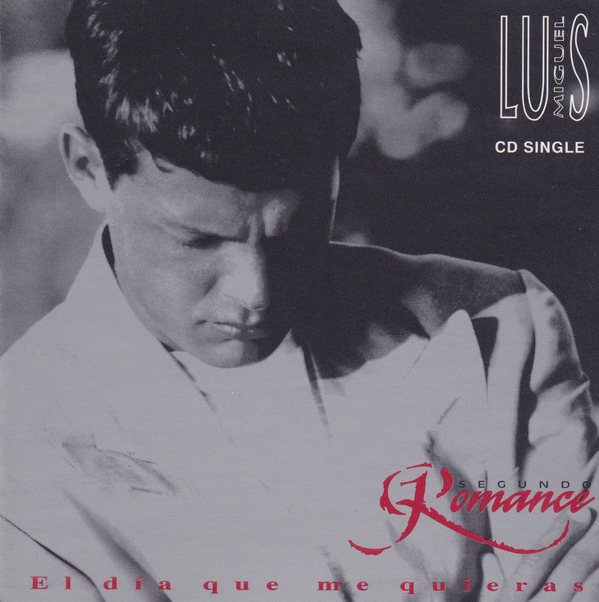
LUIS MIGUEL, “EL DÍA QUE ME QUIERAS”

17th September, 1994


Before you do anything else, you're going to want to click here. That's a link to the original version of this song, recorded in 1935 by tango pioneer, pop singer, and first Latin superstar of the twentieth century, Carlos Gardel. To get the full effect you may wish to read along with the lyrics, which I've translated (very roughly) at the bottom of this post.

Are you back? Okay.

Gardel's song, a self-consciously pastoral fantasia, a movie song (it was written by Gardel and lyricist Alfredo Le Pera for the Argentinean movie of the same name, starring Gardel), and a ballad very much in the international Thirties tradition of sumptuous sentiment married to coolly unemotional performances (compare to Bing Crosby or Dick Powell), is one of the great songs in the Latin Pop tradition, the definitive ballad of the Golden Age of Tango (ca. 1915-1955), the sudden flowering of modernism in Latin American popular culture comparable to the mixture of jazz and Art Deco in America. The tango rhythm here is almost subterranean due to the ballad tempo; only the entrance of the bandoneón in the last few choruses ties it to the traditional tango sound.

By covering this song, and by releasing it as the initial single off his new album Segundo Romance (Second Romance), Luis Miguel is explicitly placing himself as the successor to Gardel's fusion of modernism, sentiment, and iconicity -- Gardel died in a plane crash not long after recording this song, cementing his legendary status. Imagine Michael Jackson topping the charts with an Astaire cover (say "They Can't Take That Away from Me") in 1989, and you might get something of the interplay of reverence, ambition, and sheer inertial popularity at work here.

As the title of the album indicates, this is Miguel's second time laying claim to the tradition of classic Latin Pop (you may recall that the first Romance, a more strictly bolero album, produced "Inolvidable" and "No Sé Tú"), but it was far and away his most successful -- in fact it holds the record for highest-selling Latin album by a male singer of the 1990s. This probably has less to do with his fidelity to tradition than to his own magnetic self; his version of "El Día Que Me Quieras" isn't particularly faithful to Gardel's original in either chord voicing or phrasing (though he does keep the bandoneón, the instrument that sounds like a higher, thinner accordion). He converts it, essentially, into a Luis Miguel song of the 1990s, and if (like me) you have a hopeless passion for the thin crackle and low-frequency orchestras of old 78s, the blown-up keyboards and polished, glistening soup of a production is wince-inducing in comparison to the original.

But the polish and temper of Miguel's own voice cannot be denied; and if he is a worthy successor to Gardel, it is in the impeccability of his phrasing. He too paints on a sweepingly sentimental canvas, but his brushes are dry, and the song, which could easily be a wreck of overemoting in other throats, is instead a monumental sculpture, a nostalgia-free tribute to the Art Deco era in modern materials and to a modern scale. Of course, nothing ages so quickly as modernity.

Those lyrics:


11.10.10

GLORIA ESTEFAN, “CON LOS AÑOS QUE ME QUEDAN”

13th November, 1993


So "Mi Tierra" was an uptempo dance song. More in line with traditional American pop practices than with Latin ones, La Gloria's second single off the album is a ballad — or at least it's taken at a slow tempo, which isn't quite the same thing. It's still unmistakably tropical, with a back-and-forth beat that seems to fall halfway between Cuban son and Dominican bachata, with gorgeous guitar filigrees by legendary Mexican guitarist Chamin Correa that draw together two continents' worth of guitar tradition, bossa nova and tejano and trova and blues and flamenco and milonga all blinking out of the spaces between the notes.

Her performance is almost as supple and fully as tender. No virtuoso in terms of technique, for most of her career she's been notable as a vocalist mostly for her enthusiasm and brio rather than the elegant carefulness of her phrasing. But here she tackles a song whose melody is structured like traditional pop, the sort of song a jazz singer would take up, and draws the emotion out of it by sheer force of personality. I've taken to reading along with the lyrics while listening to the song, and I was tearing up by the second chorus, both the sentiment and her performance were so pitch-perfect. That shouldn't be a surprise; nothing gets to me like nostalgia.

And this is a very nostalgic record; arranged by the great Cuban jazz bassist Cachao, it uses great swaths of Hollywood strings like Max Steiner, arranging emotions in cubist friezes while Estefan's plaintive voice runs through a lyric not all that far away from the Luis Miguel entry it replaced at the top of the chart. "Con Los Años Que Me Quedan" means "with the years I have left," and the phrase is the first half of a vow, the second half of which is "demostraré cuánto te quiero" ("I will prove how much I love you"). The impulse to exaggerated displays and promises of affection is a familiar one to us from previous ballads, but the implicit acknowledgement of mortality is a new note, which is to say, of course, a very old note. Very little of this travelogue has ever concerned itself with looking backwards; as is proper to all pop, Latin Pop is concerned with the present and the future, and it takes someone of Estefan's stature and confidence to make what is essentially a 1950s torch song set in a Havana café still resonate with enough people long enough to take up residency at the top of the Latin chart for several weeks.

She wrote it with her husband, as she has most of her hits since 1984, and as with "Si Voy A Perderte," it's an entirely different song in the English-language version, which is less intimate in its emotions and more of a conventional "someday-we'll-be-together" study in deferred romance. Same melody, same backing track, different songs — this sort of two-for-the-price-of-one song will become increasingly common the closer we get to the present, as the Latin market increases in clout and visibility in the US, and as more Latin stars try to cross over in the other direction. Gloria Estefan, who's been playing both markets off each other since 1977, just had a head start on everyone else.

1.7.10

VIKKI CARR & ANA GABRIEL, “COSAS DEL AMOR”

31st August, 1991


Over the past forty years, Vikki Carr has had two almost entirely separate careers singing popular music. By which I don't mean that she had one, then she had another: she's maintained both of them side-by-side, and fans of one often know nothing of the other. Fans of traditional pop, especially the brassy 60s variety, know her as the pair of iron lungs behind "It Must Be Him," a 1967 ballad that grandly ignored all pop change since about 1953. She's maintained one foot in the trad-pop and easy listening tradition ever since, collaborating with jazz musicians, playing cabarets, and even dabbling in pop-country the way so many easy-listeners did in the 70s. But she was born Florencia Bisenta de Casillas Martinez Cardona in El Paso, Texas, and beginning in 1971 with "Que Sea Él" (the Spanish-language version of "It Must Be Him"), she maintained a Latin Pop career on the side. In the 1980s, her smooth vocals and penchant for ornate arrangements became hugely successful among the Spanish-language market, and she's cultivated that side of her career so well that she's one of the Dueñas Grandes of Latin Pop.

Here she duets with Ana Gabriel (and much as we may adore Vikki Carr, let's not kid ourselves that it was anything but Ana Gabriel's magnificent hot streak that kept this at #1 for two months) on a song where she plays the wiser older woman to Gabriel's passionately distraught young blood. Just in terms of construction, it's a solid duet, each woman getting a chance to shine, with call-and-response sections that highlight the textural differences between their voices and give the song tremendous forward momentum.

But with all that, it's still a ballad, a tremendously soppy one, and horrific in terms of its sexual politics (Carr more or less advises Gabriel to strip herself of personality in order to be whatever the man she's afraid of losing wants her to be). Love, as seemingly always in Latin Pop, is presented as tragedy, an arbitrary grand passion that will inevitably betray and leave desolate. It's just easier for me to take when it's a man complaining about it.