Showing posts with label tango. Show all posts

7.7.25

ROMEO SANTOS, “PROPUESTA INDECENTE”

28th September, 2013


"It feels good to be king," mutters Romeo Santo during a typically florid instrumental break. The not-quite Mel Brooks quotation feels entirely sincere, and only proved more so as the song soared to a global success that not even the streaming chart could really capture. It was only #1 on the Hot Latin chart for a total of four weeks in late 2013 and early 2014, but it is currently the second most-lucrative Latin song of the 2010s, behind only a certain 2017 smash. A lot of its enormous success was cumulative, though: the YouTube video reached a billion views in 2016, and although Romeo had had enormous success for a good decade prior, both with Aventura and as a soloist, it has become perhaps his definitive song for an audience that was still in elementary school when Aventura was breaking records.

The title is a direct translation of the English phrase "indecent proposal," and the lyrics live up to that steamy suggestion. Santos' lyrics have always been aimed at an adult audience, but he strips away some of his literary floweriness here in order to make a nakedly sexual advance, asking permission to seduce the listener in his car, raise her skirt, and "medir tu sensatez" (measure your sensitivity). His usual florid bachata guitar and percussion are joined occasionally by a delirious tango bandoneón, coloring the romantic Latin musical present with perhaps the ultimate avatar of the romantic Latin musical past, and placing himself firmly in the lineage of such towering Latin lovers as Carlos Gardel (and, from earlier in this travelogue, Luis Miguel).

I'm not sure that self-assignment is wholly convincing: he's a little too glib, a little too confident in his own inability to do wrong, to reach those heights, and this song, while gorgeous, isn't as affecting as much of his back catalog. Granted, I'm not in the best position to judge the effectiveness of an allosexual come-on to a heterosexual woman; but to my mind, Romeo has always been more seductive in songs where he is less certain of his chances. Those days are gone forever, though: Romeo Santos is now an institution too big to fail, with the sophomore album this was the lead single of, Formula Vol. 2, carefully engineered to do exactly twice the business of his solo debut, itself already a global smash with numrous #1s.

Still, his transition into becoming an institution means he's that much less of a pop star, and no longer needs to be down in the muck throwing elbows to fight for chart position. This is not quite our last glimpse of Romeo Santos -- although his final #1 (as of this writing) will probably be more about his duet partner than him -- but the necessity of managing his stardom portfolio will increasingly overshadow his artistic efforts. His albums still go reliably multiplatinum, but from here on out they're a smaller and smaller part of the Romeo Santos brand.

Airplay Watch:

  • Carlos Vives, "Bailar Contigo"
    • A joyous rock 'n' vallenato singalong straight out of Vives' middle-aged comfort zone.
  • Romeo Santos, "Propuesta Indecente"
    • Discussed above.
  • Yandel, "Hablé de Tí"
    • Wisin notched a solo Airplay #1 last time, so now it's Yandel's turn: a rubbery dance song with his usual AutoTune-heavy crooning and some millennial whoops to peg it firmly to the mid-2010s. Frank Gehry's Walt Disney Concert Hall dominates the video, lending it a more futuristic air than the music strictly earns.

15.9.16

MARC ANTHONY, “DÍMELO”

2nd October, 1999


Whoops.

I've been saying for some time that "Bailamos" and "Livin' La Vida Loca" were the entirety of the "Latin Invasion" that was more hyped than actual in the summer of 1999. I had forgotten about "I Need to Know," the first of Marc Anthony's two major English-language hits around the turn of the millennium. (And, of course, Jennifer Lopez was also having her first hits, and though neither "If You Had My Love" nor "Waiting for Tonight" featured any particularly Latin sounds or Spanish lyrics she would have been lumped in as well.) I can only offer by way of excuse that I was not particularly paying attention in 1999, and that "I Need to Know" has not stuck around with the tenacity of either Ricky's or Enrique's hits.

What interests me more is that "Dímelo" is the second appearance in a row of a phenomenon that, until now, has in this travelogue been confined entirely to Gloria Estefan and Jon Secada: the simultaneous release of a song in both English- and Spanish-language versions. From the vantage point of nearly two decades later, this can be understood as a mark of the music industry's turn-of-the-millennium strength or, if you like, hubris. Why not maximize profits by selling the same product to two distinct markets, and build a new generation of doubly profitable stars at the same time?

But while English-language audiences are often happy to jump on an uptempo bandwagon, they're less willing to stick around for the history lesson that earnestly respectful stars like Marc Anthony want to provide. Probably a lot of people who danced to "I Need to Know" in the second half of 1999 thought they were dancing to salsa, but the opening violin figure is very clear: it's actually a tango. (Well, really, once the cowbell gets going it's a slick, sweaty 4/4 dance song, but tango rhythms are more persistent than the mambo rhythms that define salsa.) When Marc Anthony got back to singing real salsa, it was not so well-attended.

But we'll be able to trace what happens to his dual-language career as this travelogue continues. For now, the song's the thing, and it's a great song in either English or Spanish, one of the magical pop songs of 1999, the immediately premillennial party year that seemed to respond to Prince's 1982 invocation of it by trying to create a soundtrack to utopia (or doom) worthy of the simile. Tango is, of course, a great soundtrack to romantic paranoia and obsession, the most noir of the classic Latin musics, and Anthony's performance is all needy, reckless assertiveness, demanding to know whether it's true that his beloved loves him, with such over-the-top intensity (he's dying for her love, his desire won't let him live) that any reasonable lover would be scared away. But in the heightened, cowbell-frenzied world of the song that intensity is just an emotional match for the rhythmic thrust and whirl of the music.

25.11.10

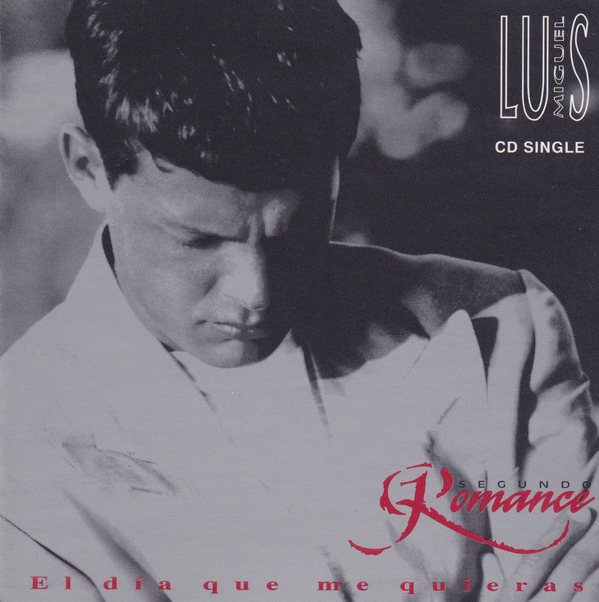
LUIS MIGUEL, “EL DÍA QUE ME QUIERAS”

17th September, 1994


Before you do anything else, you're going to want to click here. That's a link to the original version of this song, recorded in 1935 by tango pioneer, pop singer, and first Latin superstar of the twentieth century, Carlos Gardel. To get the full effect you may wish to read along with the lyrics, which I've translated (very roughly) at the bottom of this post.

Are you back? Okay.

Gardel's song, a self-consciously pastoral fantasia, a movie song (it was written by Gardel and lyricist Alfredo Le Pera for the Argentinean movie of the same name, starring Gardel), and a ballad very much in the international Thirties tradition of sumptuous sentiment married to coolly unemotional performances (compare to Bing Crosby or Dick Powell), is one of the great songs in the Latin Pop tradition, the definitive ballad of the Golden Age of Tango (ca. 1915-1955), the sudden flowering of modernism in Latin American popular culture comparable to the mixture of jazz and Art Deco in America. The tango rhythm here is almost subterranean due to the ballad tempo; only the entrance of the bandoneón in the last few choruses ties it to the traditional tango sound.

By covering this song, and by releasing it as the initial single off his new album Segundo Romance (Second Romance), Luis Miguel is explicitly placing himself as the successor to Gardel's fusion of modernism, sentiment, and iconicity -- Gardel died in a plane crash not long after recording this song, cementing his legendary status. Imagine Michael Jackson topping the charts with an Astaire cover (say "They Can't Take That Away from Me") in 1989, and you might get something of the interplay of reverence, ambition, and sheer inertial popularity at work here.

As the title of the album indicates, this is Miguel's second time laying claim to the tradition of classic Latin Pop (you may recall that the first Romance, a more strictly bolero album, produced "Inolvidable" and "No Sé Tú"), but it was far and away his most successful -- in fact it holds the record for highest-selling Latin album by a male singer of the 1990s. This probably has less to do with his fidelity to tradition than to his own magnetic self; his version of "El Día Que Me Quieras" isn't particularly faithful to Gardel's original in either chord voicing or phrasing (though he does keep the bandoneón, the instrument that sounds like a higher, thinner accordion). He converts it, essentially, into a Luis Miguel song of the 1990s, and if (like me) you have a hopeless passion for the thin crackle and low-frequency orchestras of old 78s, the blown-up keyboards and polished, glistening soup of a production is wince-inducing in comparison to the original.

But the polish and temper of Miguel's own voice cannot be denied; and if he is a worthy successor to Gardel, it is in the impeccability of his phrasing. He too paints on a sweepingly sentimental canvas, but his brushes are dry, and the song, which could easily be a wreck of overemoting in other throats, is instead a monumental sculpture, a nostalgia-free tribute to the Art Deco era in modern materials and to a modern scale. Of course, nothing ages so quickly as modernity.

Those lyrics:


11.3.10

ANGELA CARRASCO, “BOCA ROSA”

22nd October, 1988


Tracing the contours of the #1 Hot Latin songs throughout the year, I'm starting to see a pattern emerge: the summer and early fall contain upbeat songs, songs for dancing, for public display, and even when they're talking about lost love they do it with a smile. But as the nights grow longer and the air colder — even in Miami and Los Angeles, where a significant portion of the Hot Latin audience resides — the songs grow more reflective, more poetic, more in line with the long tradition of Spanish love poetry and song. And the singers grow older, more traditional too.

The Dominican-born Angela Carrasco's boom years were the 1970s, and here she assumes the confidence of a pop survivor, taking a witchy, gothic synth cathedral of an intro (it sounds a bit like a slightly cheaper take on the Siouxise of five years previous) and singing instead in a Diana Ross purr over a light synth tango rhythm.

That hint of tango — the Argentinean dance-music-turned-art-song that is global Latin culture's strongest riposte to American jazz — serves to locate this song in a specific tradition going back much further than anything we've come across yet. It comes on like a less-ironical "Love For Sale" from the opening line: "Vendo una boca rosa, ¿quién me la puede pagar?" (I sell a pink mouth; who can buy it?). We are in the eternal twilit, noir-shot underworld of tango song peopled by romantic pimps, sarcastic prostitutes and "hombres necios" (foolish men) who fall into the "trampas hechas de labios" (traps made of lips) among whom only Cole Porter and Kurt Weill, of all the major songwriters in the American tradition, would walk easily.

But of course it is still 1988, and it is still the top reaches of the Hot Latin chart, and so there is a nagging synth hook that owes more to mariachi horn lines than to tango bandoneones, and if a disco remix is more easily imaginable than a faithful tango reading, that may be due more to Carrasco's kittenish mock-sultry performance than to the structure of the written song. Except via self-conscious revivalism, tango can only be glimpsed through the distorting lens of modern pop, which (as with the way swing informed 80s R&B) is how it should be.