27th December, 1997
Our last duet was between aging superstars Juan Gabriel and Rocío Dúrcal, who were reviving the great 19th-century tradition of the son ranchero. Alejandro Fernández is quite literally of the next generation (his father was Dúrcal's exact contemporary), and Gloria Estefan, though more than ten years his senior, still plays young in the right light; the throwback tradition preserved here is the bolero of the 40s and 50s -- and Cuban bolero rather than the more noir-y Mexican version. Fernández had relied on the Estefan machine to get hits, and they came as a package; songwriter Kike Santander, producer Emilio Estefan, and La Gloria, now on her eighth appearance in these pages. (This, incidentally, now makes her the female Latin artist with the most number ones as of 1997, beating Ana Gabriel's record of seven.)
"En El Jardín" (in the garden) is a sweet song, with lovely string-ensemble decoration, and tasteful accordion and trumpet solos punctuating the proceedings. It's a love song, of course, and for once an uncomplicated one without recriminations or self-aggrandizement: things were bad, nothing gave me lasting pleasure, everything was a disappointment... and then there was You.
The transformative power of love is a perfectly ordinary subject for song, and Santander's lyrics are only notable for keeping a pretty tight leash on the central metaphor of the "jardín de mis amores" (the garden of my love), which had withered, but flourishes now under the new regime. Fernández and Estefan sell it well, particularly Fernández, whose fine voice and an excellent command of phrasing would be a pleasure in any context, but it does drag a bit, particularly when they restate the second verse and full chorus after the trumpet solo; a smart program director would no doubt have long since faded it out.
Where Gabriel and Dúrcal were presenting (even if unwittingly) something of a swan song, Fernández is just declaring his arrival, and Estefan establishing herself as the dominant female voice in the field. They respect the conventions -- but with this song, 1997 is over, and things are going to start to change rapidly.
Showing posts with label 1997. Show all posts
8.6.12
4.6.12
MARC ANTHONY, “Y HUBO ALGUIEN”
29th November, 1997
I need you to have listened to the song before you read this. Not that there's a huge spoiler or anything, but if you just click play and start reading, you won't hear what I'm talking about until two minutes in. Honor system here.
All set? Okay. Honestly, it's as if the U.S. Latin-listening public had not only anticipated my objections to the previous song (recap: sensitive ballad cover of a funky salsa original is a change for the worse), but agreed. What starts off sounding like another ultra-sensitive ballad (but classy! that string arrangement!) eventually turns into a roaring salsa barnstormer, complete with competing horn charts, popping bass, and a lengthy dénouement in which he shouts improvisatorily over the chants of his backing orchestra. The first salsa #1, Wikipedia says, and if my tags disagree I may have misidentified merengue or simply dance music with horns; certainly it's the first #1 by a performer dedicated to the genre.
Salsa, like disco, is essentially a longform medium, structurally flexible but enslaved to the rhythm, highly orchestrated, passionately performed and danced, and an implicit expression of joy regardless of the sentiments in the actual lyrics. (Disco both partly descended from salsa and developed alongside it; but where disco went electro in the 80s salsa has stayed largely true to its big-band roots, and remains a live performer's music rather than a DJ's.)
Those lyrics are where the dramatic ballad-dance structure comes in: it's programmatic music, telling a story even though the change is in mood rather than time. "Y Hubo Alguien" means "and there was someone," and the story Marc Anthony tells is that he was left broken-hearted by the song's addressee -- but it's all right, because there was someone else, someone who took care of him, sacrificed to please him, spoke kindly to him (like a woman should a man, runs the unspoken assumption). And the music and rhythm swell up in response to this joy. The second verse downshifts into a ballad gear again, as he addresses the ex with pity -- and then the chorus whirls back up dramatically, and the long salsa workout that finishes out the song is rubbing it in her face: "I cried over you, now it's your turn to cry a while." Both the sentiment and the music are traditional (well, dating to the 70s), but details of the production (the funky slap bass) and especially Anthony's rich, flexible voice make it thoroughly modern.
For here is another brick in the edifice that is the Latin music world as we know it today: Marc Anthony's first #1, the first single off his third album, carefully dramatized and orchestrated to be a massive hit -- he is of the generation of Enrique Iglesias and Alejandro Fernández, and together they represent the tripartite coalition of Latin music within the United States: Iglesias the international playboy and pop star, Fernández the Mexican craftsman and ranchero, and Anthony the Nuyorican soulman and salsero. The album, Contra la Corriente (against the current), with its starkly miminalist cover, posits Anthony as a Real Musician, modern but also out of time, a salsa belter dressed like Paul Simon in 1969. Of the three, he intrigues the most, and I know least what to expect from him as we barrel into the future.
Labels:
1997,
marc anthony,
new york,
puerto rico,
romantica,
salsa,
tropical,
usa
1.6.12
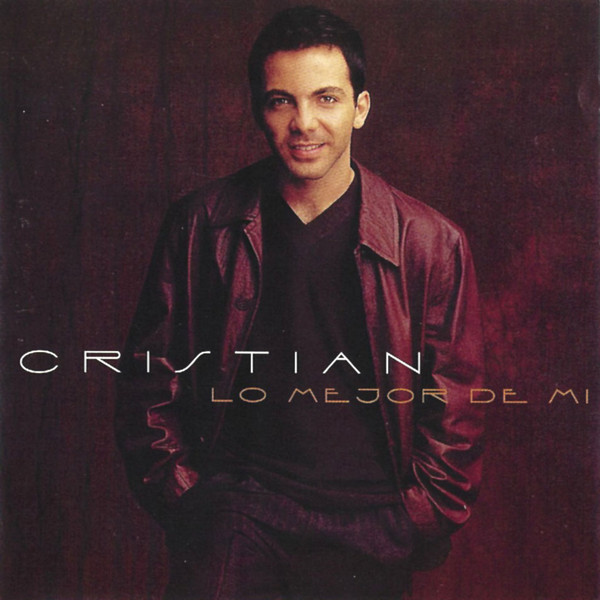
CRISTIAN CASTRO, “LO MEJOR DE MÍ”
22nd November, 1997
As regular readers of this travelogue are aware, I'm fairly skeptical of ballads, demanding to be impressed by great writing, great singing, or great arranging before letting any low-bpm romanticism past my rock-reared defences. So I was already listening to this with one eyebrow raised, as it were, from the very first notes.
And?
It's not bad! Castro's found his own rather fine voice -- no longer shamelessly aping Luis Miguel, he's found his own tricks of intimacy -- and it's tastefully-arranged, with lovely acoustic guitar runs and actual piano instead of electric approximations, and a slow saunter of a bolero rhythm underpinning the whole thing. If it's not lyrically a knockout, well, it's a conventional romántico ballad. "Lo Mejor de Mí" means "the best of me," and the chorus is a complaint that he's given her his best, but it's not enough, she keeps hurting him and he doesn't deserve it.
But then I clicked over to Wikipedia to check up on any facts I needed to know, and saw that it was a cover of Rey Ruiz's 1991 original. And, well, I'm sorry, Cristian, but a danceable salsa ballad is always going to kick a self-important dirgey ballad all to hell. I know I'm something of a hypocrite here, because I love nothing more than a good wallow when I'm romantically rejected, but Ruiz's version, in which it can never get that bad as long as there's dancing and buddies you can do a call-and-response with, is infinitely more attractive to listen to.
29.5.12
ALEJANDRO FERNÁNDEZ, “SI TÚ SUPIERAS”
18th October, 1997
As if to prove that Enrique Iglesias isn't the only son of a famous Latin singer of the 70s and 80s who can command attention, respect, and screaming devotion, here's another extremely recognizable last name. Although we did, if briefly, meet Julio Iglesias early on in this chart voyage, we never directly encountered Vicente Fernández. This is more or less an effect of when the chart began; if it had been running in the 70s and early 80s, he would have waged serious siege to Iglesias' domination. Fernández pére was (and still is) the greatest ranchera singer of his generation and arguably of all time, comparable perhaps to George Jones' position in country music, and if his music didn't always have the transnational appeal of Julio Iglesias pére's, the devotion of his Mexican and Mexican-American fanbase was, and remains, a force to be reckoned with.
Fernández fils began his career following in his father's footsteps, with ranchera and mariachi albums in the early 90s, and had moderate-to-high levels of success. But in 1997 -- and I can't imagine he didn't have one shrewd eye on the stunning success of baby-faced Iglesias fils -- he joined up with Emilio Estefan and Kike Santander, the twin forces behind the throne de la Gloria, and recorded an album of modern bolero, not unlike what Luis Miguel has been doing, but more dynamically arranged. If he was attempting to challenge Enrique for top-of-the-chart supremacy, it worked: "Si Tú Supieras" ("if you knew") was the biggest Latin hit of the second half of 1997, with Fernández' strongest advantage over Iglesias -- his polished, resonant voice -- front and center.
The song itself is only so-so; a languid bolero with flamenco touches on the guitar, it's a ballad of romantic longing, as the title suggests. The most remarkable thing about it is the chorus, in which he expresses a desire "para sembrar mil rosas nuevas en tu vientre" ("to plant a thousand new roses in your womb"), an arresting image that (though I believe it's a spin on an existing Spanish idiom) has become something of a touchstone for online Hispanophone flirtation. It's a strong production, as you would expect from the Estefan machine, and if Fernández still sounds a little formal, acountry Mexican singer feeling stiff in these city Miami duds, he'll doubtless grow into them.
As if to prove that Enrique Iglesias isn't the only son of a famous Latin singer of the 70s and 80s who can command attention, respect, and screaming devotion, here's another extremely recognizable last name. Although we did, if briefly, meet Julio Iglesias early on in this chart voyage, we never directly encountered Vicente Fernández. This is more or less an effect of when the chart began; if it had been running in the 70s and early 80s, he would have waged serious siege to Iglesias' domination. Fernández pére was (and still is) the greatest ranchera singer of his generation and arguably of all time, comparable perhaps to George Jones' position in country music, and if his music didn't always have the transnational appeal of Julio Iglesias pére's, the devotion of his Mexican and Mexican-American fanbase was, and remains, a force to be reckoned with.
Fernández fils began his career following in his father's footsteps, with ranchera and mariachi albums in the early 90s, and had moderate-to-high levels of success. But in 1997 -- and I can't imagine he didn't have one shrewd eye on the stunning success of baby-faced Iglesias fils -- he joined up with Emilio Estefan and Kike Santander, the twin forces behind the throne de la Gloria, and recorded an album of modern bolero, not unlike what Luis Miguel has been doing, but more dynamically arranged. If he was attempting to challenge Enrique for top-of-the-chart supremacy, it worked: "Si Tú Supieras" ("if you knew") was the biggest Latin hit of the second half of 1997, with Fernández' strongest advantage over Iglesias -- his polished, resonant voice -- front and center.
The song itself is only so-so; a languid bolero with flamenco touches on the guitar, it's a ballad of romantic longing, as the title suggests. The most remarkable thing about it is the chorus, in which he expresses a desire "para sembrar mil rosas nuevas en tu vientre" ("to plant a thousand new roses in your womb"), an arresting image that (though I believe it's a spin on an existing Spanish idiom) has become something of a touchstone for online Hispanophone flirtation. It's a strong production, as you would expect from the Estefan machine, and if Fernández still sounds a little formal, a
Labels:
1997,
alejandro fernandez,
ballad,
bolero,
kike santander,
mexico,
miami,
pop idol,
romantica
24.5.12
MARCO ANTONIO SOLÍS, “LA VENIA BENDITA”
11th October, 1997
Since Los Bukis’ very first appearance in these pages, I’ve used the “regional” tag on both their and Marco Antonio Solís’ songs. If this is the first time it actually sounds directly applicable, that has more to do with evolving standards of identification with Mexican regionalismo than with an actual change in genre. For students of country music, a comparison with, say, the difference between Ronnie Milsap and Randy Travis in the mid-80s might be useful: both of them were certainly country musicians, but Travis’s neotraditionalism helped to spark a sea change in how country identified itself, so that Milsap’s AC-friendly glossiness now sounds hopelessly dated and unreal. Given the increasing visibility of tradition-minded ranchera, tejano, mariachi, and norteño at the top spot of the Latin chart in the mid-late 90s, Solís is just blowing with prevailing winds.
“La Venia Bendita” (lit. “the blessed arrival,” but see below for an in-context translation) takes the hypertraditional form of a ranchera waltz, complete with mariachi horns and two incandescent, sobbing gritos, one right at the beginning and another at the first completion of the chorus. Its traditionalism is entirely understandable: it’s a wedding song. Not explicitly so (explicitly occasional songs are almost universally terrible), but just take a gander at this chorus:
Besame así despacito y alarguemos el destino
Pues este amor tan bonito que se nos dío en el camino
Tiene la venia bendita del poderoso divino
Kiss me so, slowly, and let us prolong our destiny
For this love so beautiful that has put us on the road
Has the blessing of the Divine Almighty
The verses are similarly hyperbolically sentimental (there’s even a reference to the grave the lovers will share in time), but the astringent rhythm and sweet-sour horns cover a lot. Solís being Solís, his melody doesn’t follow traditional ranchera templates — which is good, because his voice isn’t strong enough to tackle, say, a Vicente Fernández song. Still, it’s the first Solís song I’ve unequivocally enjoyed (I’m totally an authenticitymonger, sadface), and I hope he got nice fat royalties out of the millions of walks down the aisle set to it.
3.4.12
JUAN GABRIEL, “TE SIGO AMANDO”
4th October, 1997
Because it is occasionally the case that songs given exposure by movies or television shows become massive hits in Anglophone pop, it can be perilously tempting for Anglophone listeners to assume that the relationship between telenovelas and Latin pop is easily analogous. But just about any music supervisor in Hollywood would kill to have the cultural reach the most popular novelas do — far from being merely "soap operas in Spanish," for decades they've combined being Event Television like HBO dramas, telling complete stories like British series, and moving propulsively, not to say trashily, forward with the gonzo pulp energy that fuels not just soap operas but superhero comics, reality television, political campaigns, and pop music. Because telenovelas don't aspire to Art, they can share their giddy, lurid energy with the pop craftsmen who write and sing their theme songs; and if Art takes place incidentally along the way, no one really minds.
Juan Gabriel should be a familiar name in these pages by now; his own tempestuous battle with his label for money, status, and integrity works as an echo for the themes of the novela Te Sigo Amando (I still love you), in which a beautiful young woman is forced to marry a cruel millionaire while her honorable surgeon lover watches impotently. (Per Wikipedia, anyway.) It's a sign of the respect in which Gabriel was universally held by the Latin entertainment complex — for his hitmaking ability, of nothing else -- that his bleat of a voice (sounding all the rougher in these pages after the exquisite dulzura of Luis Miguel) was not sweetened at all for the signature song of a major broadcast event. Just getting him was no doubt coup enough.
It's a traditional-sounding song (not unexpected, given the both the first and the most recent songs we've heard from Gabriel), a florid waltz with big-band mariachi instrumentation, and the lyric is traditional too, a vow of renunciation and at the same time of unending love. The repeated line "Que seas muy feliz" (may you be very happy) is its own classic of the romantic genre; and if it's more calculated to make the man feel he's being noble than to tend to the woman's happiness, there's plenty of precedent for that. This is the level, of course, on which telenovelas function: grand passions, magnificent gestures, sobs all round. Juan Gabriel's voice keeps it tethered to earth, as does an arrangement that manages to be grand without feeling busy: Gabriel's sense of space and when to insert the exactly appropriate instrumental flourish is unimpaired.
Labels:
1997,
ballad,
juan gabriel,
mariachi,
mexico,
pop royalty,
regional,
romantica,
telenovela,
waltz
31.1.12
LUIS MIGUEL, “POR DEBAJO DE LA MESA”
6th September, 1997
Romances was Luis Miguel's third album of classic boleros and love songs from the rich history of twentieth-century Latin music. As Rod Stewart would find a decade later, it was almost impossible not to keep indulging his audience's nostalgic streak; the records sold too well.
Even the fact that "Por Debajo de la Mesa" (underneath the table) isn't a classic, but a new song written by Miguel's long-time producer for the Romance series (Armando Manzanero, himself a classic song composer of the 60s, 70s and 80s) speaks to the exhaustion that's begun to set in, not only with the series, but with Miguel's own pop career. Only twenty-seven at the time of release, he's already accomplished more than he could have dreamed; and the kids are coming up from behind. Miguel's standard of four hits a year has been slipping for a while, and will only slip away in the years to come. You can build quite a nice career on nostalgia, as thousands of aging entertainers have found; but at least in the modern world, you can't be a pop star too.
"Por Debajo de la Mesa" is a love song — underneath the table he caresses her knee, and then spends the rest of the song wondering what will happen next. Will she accept his advances, will she awaken the fire in his blood? He can't live without her, etc. It's a professional song, professionally arranged, but while Miguel sings it with all the tenderness at his command, he can't make it into a timeless work of beauty. It's filler — gorgeous filler, but filler. And the kids are coming up from behind.
Labels:
1997,
armando manzanero,
ballad,
bolero,
luis miguel,
mexico,
pop royalty,
romantica
14.11.11
ENRIQUE IGLESIAS, “MIENTE”
16th August, 1997
And then, finally, eight singles in to his all-conquering chart run -- all eight of which have hit the top spot, a Latin Pop record and a pretty unassailable accomplishment no matter what chart you're looking at -- Enrique Iglesias found his sound. Not that he's singing any differently: the choked whine he employs here is, if anything, even more choked and whinier than on his debut. But the production for once matches him, equal parts bouncy and dramatic, forward motion with an emotional content built into the chord structure. Freed from the necessity of being the most interesting thing about the song, he can to some degree disappear into its rhythmic thrust, and if he still sounds a little ridiculous, it's the forgiving ridiculousness of camp rather than that of trying, and failing, to be tenderly sincere.
The winding-up-and-twisting down electric piano line against a rather limp breakbeat is one of the key sounds of mid-90s kitsch, electronic music gesturing towards classical, or earlier, forms (cf. Enigma, Miranda Sex Garden, that one Sarah Brightman record): if the melody's not actually from a moody Bach fugue, it means to sound like it. (The attack and sustain on the piano even drift toward the sound of a harpsichord.) The textural rock guitar and sonic drift layering out the record gives it a punch that rescues it from limp New Age mood-setting; and then, of course, there's Iglesias singing the actual song.
"Miente" means "lie" (both the noun and -- the sense in which the lyric uses it -- the imperative verb form). He's begging her to lie, to say that she loves him, because he can't live without her. It's appropriately hyperbolic stuff, dramatic to match the dramatic mood of the music, and though he delivers it with his usual conviction, the rhythmic pulse of the song protects him from lugubriousness. It's the best song we've heard from him yet, but it's still not among his best songs; we've got a few years before he begins to regularly turn out material on this level.
Labels:
1997,
enrique iglesias,
pop royalty,
rock en espanol,
spain,
usa
25.10.11
GLORIA ESTEFAN, “NO PRETENDO”
2nd August, 1997
Probably the most telling indication of my taste-slash-white-boy-assumptions-about-"real"-Latin-music is the reaction I'm having to this run of songs compared to the run that immediately preceded it. Enrique Iglesias and Marco Antonio Solís, much as I've liked individual songs of theirs, are wearying in romántico ballad after romántico ballad slicked up with mid-90s adult-contemporary pop production. The ranchero classicism of Juan Gabriel/Rocío Dúrcal and the countryfied corridos of Los Tigres del Norte, leaning as they did on traditional Mexican sounds, the Latin American version of "roots" music like the blues, country and gospel, were much more agreeable to my classicist's ears. Which may be indication of an "authenticity"-driven double standard applied to Latin music — after all, in Anglophone music of the period, I like the Cardigans way more than, say, Keb' Mo' — or maybe it's just a numbers game. If it were one or two Enriques to every six or seven Tigres, I might be feeling the exact opposite.
I bring all this up because this is the third Latin-traditionalist song in a row that I'm really loving; though the traditionalism here isn't Mexican but Cuban, even Spanish (the flowing flamenco-like guitar lines), and I think I even hear Peruvian huayño (cf. "El Condor Pasa") in the shuffling rhythm. But I'm no expert, as the musicologists falling over themselves laughing at my disorderly tags can attest. And faithful traditionalism would surely be pointless without Estefan's effortless melodicism and Kike Santander's classic songwriting.
"No Pretendo" can be translated several different ways, from the obvious "I don't pretend" to "I'm not trying" to "I don't mean" — either way, the phrase ends most frequently with "ser tu dueña" (be your lady, in the aristocratic as well as the lover sense) and "hacerte mío" (make you mine), and the repeated disclaimers have the effect of enforcing humility: after saying at great length what she doesn't mean to be, when she says what she does want to be it's "el mano que se llene de quebranto, ser un poco el remanso donde muere el desengaño" (the hand filled with broken dreams, a bit of an oasis where disappointments die).
This is practically Victorian — the "ministering angel thou" version of womanhood, rejecting any stronger moral or emotional hold on her man — but the complexity and the sheer poetry of the full lyric make it go down easier, as does Estefan's eternally warm voice, pitched at just the right level of desperation to make the sentiment believable. And listen to the guitars: they're letting us know it's tragic, all right.
10.10.11
LOS TIGRES DEL NORTE, “EL MOJADO ACAUDALADO”
19th July, 1997
The last time we heard from Los Tigres, they were taking on corruption and systemic failure in the Mexican government. Their return engagement to the top of the chart, in contrast, sees the most fearless conjunto in norteño engaging directly with the immigrant experience. "El Mojado Acaudalado" means "The Prosperous Wetback" (the slur is comparable, maybe, to the way country music has reclaimed "redneck"), and the lyrics are as plain and direct as any we've seen:
Me estés esperando Mexico lindo
Por eso mismo me voy a ir
Soy el mojado acaudalado
Pero en mi tierra quiero morir
(Beautiful Mexico, you're waiting for me
That's just where I'm heading to
I'm the prosperous wetback
But I want to die in my own country)
The crisp stomp backing up this bone-dry recitative is beautiful in its spareness, a repeated descending bassline as close as we get to any instrumental flourishes. The fact that the song opens with the chorus sung by a child is perfectly appropriate: it's simple enough for a child (or an uneducated laborer) to sing, as plain as a hymn, as straightforward as a nursery rhyme. Comparisons with country music, especially Johnny Cash's bone-dry rattle or Hank Williams' brusque eloquence, are inevitable; and in the roundup of American placenames to which the narrator is saying goodbye, it echoes the grand old country tradition of a travelin' song. But it also positions him as much American as Mexican -- W. E. B. DuBois' notion of "double consciousness" is as applicable to the immigrant laborer as to the black American.
For the nth time, I'm not rating these out of ten. I suspect, though, that if I was, this would beone a ten.
The last time we heard from Los Tigres, they were taking on corruption and systemic failure in the Mexican government. Their return engagement to the top of the chart, in contrast, sees the most fearless conjunto in norteño engaging directly with the immigrant experience. "El Mojado Acaudalado" means "The Prosperous Wetback" (the slur is comparable, maybe, to the way country music has reclaimed "redneck"), and the lyrics are as plain and direct as any we've seen:
Me estés esperando Mexico lindo
Por eso mismo me voy a ir
Soy el mojado acaudalado
Pero en mi tierra quiero morir
(Beautiful Mexico, you're waiting for me
That's just where I'm heading to
I'm the prosperous wetback
But I want to die in my own country)
The crisp stomp backing up this bone-dry recitative is beautiful in its spareness, a repeated descending bassline as close as we get to any instrumental flourishes. The fact that the song opens with the chorus sung by a child is perfectly appropriate: it's simple enough for a child (or an uneducated laborer) to sing, as plain as a hymn, as straightforward as a nursery rhyme. Comparisons with country music, especially Johnny Cash's bone-dry rattle or Hank Williams' brusque eloquence, are inevitable; and in the roundup of American placenames to which the narrator is saying goodbye, it echoes the grand old country tradition of a travelin' song. But it also positions him as much American as Mexican -- W. E. B. DuBois' notion of "double consciousness" is as applicable to the immigrant laborer as to the black American.
For the nth time, I'm not rating these out of ten. I suspect, though, that if I was, this would be
Labels:
1997,
corrido,
los tigres del norte,
mexico,
norteno,
regional,
sinaloense,
usa
3.10.11
JUAN GABRIEL &; ROCÍO DÚRCAL, “EL DESTINO”
14th June, 1997
The title of their album, one of the best-selling of the year (it went gold in Mexico, but double platinum in the United States — which should tell you something about the Latin-music marketin the 1990s), was Juntos Otra Vez (together again), and even I, who know very little about either Dúrcal or Gabriel, can't help but feel sentimental about their reunion. The beginning of this journey may have been entirely arbitrary, but it began with her singing a song written by him, and this final pairing, just before she developed the lung cancer that would eventually kill her, is very much a fitting swan song, sweeping, majestic, and sumptuously reveling in the fine details of their voices, both separately and together.
Juntos Otra Vez was written and performed as a stage show — performed in a sumptuous opera house in Jalisco, the heart of the nineteenth-century son ranchera movement that Gabriel is evoking with his compositions and orchestrations — and released both as a studio album and a live video. You can see the video of "El Destino" above; its artificial staging and odd light show feel very 90s, but the music is timeless, echoing both nineteenth-century Mexican romanticism and Gabriel's old orchestrations from the 80s (those puffs of trumpets are very like the synthesized horns decorating "La Guirnalda").
The song is equally timeless, a love song — "¿me quieres?" (do you love me), she begins, and he echoes "te quiero" (I love you) — built on an epic scale, meant to soundtrack an epic romance. True to Gabriel's form, however, it's surprisingly bloodless — there's no carnality to the lyrics, no passion (though you could say that he and Dúrcal provide all that's necessary). "Soy tu amigo y tambien tu hermano" (I am your friend and also your brother), he sings at one point, as though brotherly friendship is the stuff of epic romance.
All of which perhaps makes the point that it's a true portrait of the relationship between Juan Gabriel and Rocío Dúrcal. They clearly held each other in great regard and affection — and indeed neither of them was ever as great separately as they were together — but it was a platonic, professional love. Platonic love, however, doesn't pay the pop radio bills. This song was only number one for a week, a tribute to the affection in which both singers were held by the wide Latin audience; but it also marks the end of an era. Newer, younger voices are coming up from behind.
The title of their album, one of the best-selling of the year (it went gold in Mexico, but double platinum in the United States — which should tell you something about the Latin-music market
Juntos Otra Vez was written and performed as a stage show — performed in a sumptuous opera house in Jalisco, the heart of the nineteenth-century son ranchera movement that Gabriel is evoking with his compositions and orchestrations — and released both as a studio album and a live video. You can see the video of "El Destino" above; its artificial staging and odd light show feel very 90s, but the music is timeless, echoing both nineteenth-century Mexican romanticism and Gabriel's old orchestrations from the 80s (those puffs of trumpets are very like the synthesized horns decorating "La Guirnalda").
The song is equally timeless, a love song — "¿me quieres?" (do you love me), she begins, and he echoes "te quiero" (I love you) — built on an epic scale, meant to soundtrack an epic romance. True to Gabriel's form, however, it's surprisingly bloodless — there's no carnality to the lyrics, no passion (though you could say that he and Dúrcal provide all that's necessary). "Soy tu amigo y tambien tu hermano" (I am your friend and also your brother), he sings at one point, as though brotherly friendship is the stuff of epic romance.
All of which perhaps makes the point that it's a true portrait of the relationship between Juan Gabriel and Rocío Dúrcal. They clearly held each other in great regard and affection — and indeed neither of them was ever as great separately as they were together — but it was a platonic, professional love. Platonic love, however, doesn't pay the pop radio bills. This song was only number one for a week, a tribute to the affection in which both singers were held by the wide Latin audience; but it also marks the end of an era. Newer, younger voices are coming up from behind.
Labels:
1997,
ballad,
duet,
juan gabriel,
mariachi,
mexico,
pop royalty,
ranchera,
regional,
rocio durcal,
spain
29.9.11
ENRIQUE IGLESIAS, “SOLO EN TÍ”
3 May, 1997
Two covers in a row! The original of this one may be slightly more familiar to my English-language readers than Vicente Fernández; it is, of course, Yazoo's "Only You." (Enrique also covered the original and released it at the same time to English-language markets; but his time as an Anglophone hitmaker was not yet.)
As a cover of "Only You," it's only okay; the cheap-sounding keyboard presets are no match for the synthetic worlds of 1982, and Enrique, no matter how hard he emotes, will never be Alison Moyet. The melody, however, is a timeless one, and the Spanish lyrics, if not as subtle as the original (which is pretty universally true of translated songs no matter which direction they're going), are a fairly faithful rendition of the sentiment.
So as an Enrique Iglesias song, at least by the standard set in his early years, it's a qualified success. The limited range of the melody, typical of the synthpop pioneers who were generally better at programming than singing, prevents Enrique from indulging his habit of turning everything into self-serving melodrama; there's just not enough there to oversing.
26.9.11
LOS TEMERARIOS, “YA ME VOY PARA SIEMPRE”
26th April, 1997
The first song to break the Iglesias/Solís streak is also the third live norteño song in three years, and the ninth time I've had occasion to break out the "cover" tag. The cover here is of Vicente Fernández' late-70s hit "Ya Me Voy Para Siempre" (you can, and should, see him lipsync to it in the 1980 movie Picardia Mexicana II here), and Los Temerarios, who were a romántico band, not a norteño one, make only a decent fist of it, studio instrumentation filling in the weak spots in their live act.
The Fernández original is a grimly comic song of lost love: "Si sigue este dolor, no le sorprenda que mi hogar sea una cantina," runs the repeated bridge. ("If this pain continues, don't be surprised that my home is a tavern.") Which fit perfectly with Fernández' working-class hero image — in the movie, he ends the song by vowing future loyalty only to the comic proletariat of the supporting cast — but among the moneyed classiness of the mid-90s Latin chart (or that portion of it we're hearing) is something of a shock.
Gustavo Ángel, the singing Ángel brother of Los Temerarios (their name means "the reckless ones") goes for a more dramatic reading than Fernández' classically balanced blue-collar mariachi version (the difference is maybe not dissimilar to Alan Jackson covering George Jones), and he gets off a fantastic grito and shout out to the Temerarios' home state of Zacatecas, but the bulk of the energy here comes from the crowd singing lustily along with the "porque el amor de mi vida solito me dejó" refrain. ("Because the love of my life left me all alone.") Still, I can't be mad at anything that breaks up the pop-establishment ballad monotony.
20.9.11
ENRIQUE IGLESIAS, “ENAMORADO POR PRIMERA VEZ”
1st February, 1997
The thing to always keep in mind is that I'm ever only discussing a tiny portion of what was in the Hot Latin chart at any given time. So what is recorded, in this blog, as an unbroken string of romantico ballad after romantico ballad, Enrique and Marco Antonio following each other like night after day, was only a small part of a dynamic and ever-shifting Latin Pop scene which included hot dance jams, innovative rock en español acts, keeping-the-faith traditionalists in Mexican regional styles, and flashy novelty pop hits as well. By early 1997, Los Del Rio's "Macarena" has, alas, come and gone, reaching only #12 on the Latin chart even as it hit #1 on the Hot 100; it was always more of a tourist jingle than an organic Latin hit.
Instead we have the sixth Enrique Iglesias number one in fifteen months; Enrique Iglesias, his self-titled debut, has stuck around for so long that it's nearly in danger of running into the follow-up. Vivir, the Gorgeous One's second album, was (of course) hotly anticipated, and "Enamorado Por Primera Vez" ("In love for the first time") went straight in at #1, only the second song in Latin chart history to do so. It's a step up in terms of production, if not in vocal quality or songwriting: though a ballad — a power ballad, even! — it's very much a rock song according to its instrumentation. Soft rock, sure (the Bryan Adams of 1991 would surely raise an eyebrow in recognition), but the the guitars shred and the drums clump like very little we've had on the chart before.
This is a point where I'd love to hear from anyone who was in the Enrique demographic at the time: for someone who is (arguably) the most iconic and commercially powerful Latin Pop star of the past several decades, he's inspired relatively little fan-oriented chatter, and I can't really reconstruct, from my Anglo male 21st-century citadel, what his appeal was; or at least what drove the (commercial) response to him in a way it didn't, really, for anyone else. Lots of guys are pretty, after all. Did the famous name cross the generation gap and make his success a foregone conclusion no matter what he did? Were there extracurricular appearances I'm not privy to which made him more of a heartthrob than just a guy smoldering in a video clip? Am I just not hearing the music properly?
Labels:
1997,
ballad,
enrique iglesias,
power ballad,
rock en espanol,
romantica,
spain,
usa
16.9.11
MARCO ANTONIO SOLÍS, “ASÍ COMO TE CONOCÍ”
11th January, 1997
We're deep into that odd stretch of the Hot Latin chart where the top spot alternates between Marco Antonio Solís and Enrique Iglesias with no intermission, and if you're getting sick of it I can't blame you. But skipping irritatedly over Solís' third number one in a row over the same album would be a mistake: it's the best yet.
No doubt I've mostly come to this conclusion because I'm a sucker for Farfisa organs, and the opening riff and later solo are different enough from the usual romántico instrumentation that it caught my ear; but I also appreciate the old-fashioned bolero rhythm and construction, the tasty nylon-stringed guitar playing (sounding like current pop-bachata a decade early), and Solís' carefully-constructed, grown-up lyric. "Así Como Te Conocí" means, roughly, "The way I came to know you," and he draws a portrait that manages to be both clear-eyed and romantic about the end of a relationship. Though he falters into romántico conventionality ("sé que solo fui tu pasatiempo" / "I know I was only your pasttime"), it's mostly as assured a lyric as you might expect from the most acclaimed Latin songwriter of the 90s.
Subscribe to:
Posts (Atom)