17.6.10

BANDA BLANCA, “SOPA DE CARACOL”

16th March, 1991


Ahh, at last. Entries like this one make me regret my decision to not copy Popular in all things and refrain from giving scores; if ever there was a first 10-out-of-10 begging to be given out, this was it.

Of course there's personal history here, as there should always be with a 10.

In the summer of 1990, when I was twelve, my family moved from Arizona to Guatemala so that my parents could be missionaries in the most heavily missionized country in the Western Hemisphere. Apart from several months at language school, where I learned Spanish largely by immersion, I never really identified with, participated in, or even felt comfortable with the local culture. Part of this is because I was a shy, introverted kid and would have felt just as out of place anywhere, but part of it is because I went to an English-language school, surrounded by other missionary kids, listened to the English-language stations on the radio, and spent my teens living what I now recognize as an extremely privileged, even colonialist lifestyle, in which the only regular contact I made with Guatemalans was as servicepeople. That old colonialist's line, "lovely country, pity about the people," would have disgusted me if I'd heard it spoken aloud, but I almost never conducted myself in any way that would have contradicted it.

So when I say that this song is the first song in this travelogue so far that I knew at the time, I don't want to be misunderstood. I didn't hear it as pop, the way I heard "I Love Your Smile" and "Mr. Wendal" and "Runaway Train" on the radio, hoping and waiting around for them to come on, knowing who it was sang them, having an opinion about their relative merit as compared to everything else on the radio — I heard it as background noise, as the kind of thing that would be played on outdoor speakers during Sundays in the parque central, or at the occasional saint's-day fiesta to which we ventured, excited and a little nervously, and possibly as one of the videos which washed over me in undistinguished mass on the fuzzy local music-video channel while I waited for the English-language hour to come on.

Nevertheless, that horn line, that rhythm, those Garifuna shouts — "iupe! iupe!" — and most of all, that stutter-and-release of a refrain, chanted irregularly throughout the song, are so deeply embedded in the back of my mind that it functions in much the same way as pop music does for those lucky enough to have grown up with it (before my parents were missionaries, they were very strict about what we listened to), as an invisible presence clouding and coloring an entire portion of your life, something you never consciously sought out but nevertheless know intimately, like family or home.

That refrain — "si tú quieres bailar... sopa de caracol! jey!" (tr. "if you want to dance... conch soup! hey!") — is if possible even more meaningless than the rest of the "lyrics," which mostly aren't in Spanish but in the Garifuna language of the Caribbean coast of Central America. It's a rare example of a Central American hit that, however briefly or novelty-like, stormed the rest of Latin American pop for a season. But while I don't suppose it left much of a trace on the Billboard Hot Latin chart, where it reigned at the top for only two weeks, it was more or less a standard in Guatemala for years, a hip-moving guaranteed dancefloor-filler that I clearly remember hearing in 1996, as we were preparing to move back to the States, and being surprised by how familiar it was since I never listened to Spanish-language music.

My six years in Guatemala were spent almost entirely inland, so I don't know much about Garifuna culture beyond what I gather from Wikipedia, but I will state for the record that this is not salsa or merengue, despite the similarity of a tropical rhythm with horns, but punta, the Central-American coastal dance music which moves in tighter circles and sounds (to my not-very-educated ear) more like the chant-like indigenous folk music I was as likely to hear as Latin pop coming from stereos and sound systems in the tourist town of Antigua. Banda Blanca were from Honduras, and their silly ode to a standard Honduran national dish (I was taught that "caracol" meant snail, but apparently it can refer to any mollusk) was the breakthrough punta hit of the 1990s. Like most such, it was of course seen by devotees of the form as a childish bastardization for degraded mass tastes; which is of course the most pop thing of all about it.

Listening to it today, I'm not exactly whisked back to my early youth — it was only in the air, it never reached me emotionally then — but I am moved to dance, to whoop along, and to reflect guiltily on how many opportunities for knowledge, understanding, joy, and human connection I missed by being a self-involved, self-important American teenager. There are only a few other big Spanish-language hits I remember noticing from those years, but a glance at the list says they won't be troubling us. I'll probably manage to talk about them anyway, whether here or elsewhere; in self-involvement and self-importance, at least, I haven't changed.

14.6.10

MYRIAM HERNÁNDEZ, “TE PARECES TANTO A ÉL”

16th February, 1991


In some ways this feels like a throwback, but I'm not sure whether that's because it really is or if it's just fallen out that we've had a run of more "modern"-sounding ballads. And anyway, this only recalls the far-flung, dimly-remembered era of 1988, when traditionally-structured songs about the inevitable doom of romance and the necessity of grasping at fleeting moments of happiness before it all turns to shit were all the rage. (I may be misremembering. I'm not reading the archives to check.)

It's a somewhat more lively ballad than the kinds we've been having recently, but that only means it has a strong, synth-pulse rhythm; the sound of the record is still very much a soup of glossy keyboards and distant gated drums. The lyrics are all that really catch at the attention; even Hernández' voice is a little weak for the kind of agonized stateliness required here.

The title translates to "you look so much like him," and indeed it's a song that compares the current lover to an old lover, one who made life a living hell until she had to leave. But she knows that the same pattern will repeat again here; not only does he look like him, he acts, moves and loves like him, and she's just waiting for the day when "llegue a suceder lo que sospecho" ("what I suspect will happen happens"). Apparently she has a type, would be the cynical reading of the song; but of course in the heightened, stormy telenovela romanticism of traditional Latin pop, this is all the inscrutable working of an unkind destiny, a Cathy and Heathcliff and Heathcliff in adult-contemporary drag. Myriam, unfortunately, is no Kate Bush; and so the song slides slickly away from attention and memory and fails to provoke any responding passion.

10.6.10

ANA GABRIEL, “ES DEMASIADO TARDE”

8th December, 1990


Those who have followed the low-level mystery of format release in this travelogue may be intrigued to learn that although this song reached the top of the Hot Latin chart in December 1990 and stayed there through February of 1991, I can find no release of the song dating back earlier than 1992, on a greatest-hits compilation called Personalidad. Whether this is because the Internet in its infinite wisdom has overlooked recording the existence of any Latin single release before about 1994, or because the makers of tracklistings of Rapidshare downloads (which gentlemen and scholars are the only people anywhere who bother giving discographical details on artists that the rest of the Internet is too bougie, white and indie-rock to give a fuck about) got something wrong somewhere, I can't say.

But Ana Gabriel, though one of the more frequent visitors to the top spot here, is also one of the most welcome presences whenever she appears. I've complained passive-aggressively about the domination of 1990 by ballads, and while this is undeniably a ballad — it even starts with those same glistening, watery keyboards that every goddamn song since "Volaré" has started with — it has stronger roots than most of this stuff. You see, it's a ranchera song.

I note from a quick perusal of my tags that I haven't had occasion to talk about ranchera before, so I'll do it now. The easiest shorthand is to call ranchera "Mexican country music," and while it does serve some of the same functions and even grew out of some of the same cultural conditions (the word itself means "from the ranch," i.e. cowboy music), its roots are as much in showbiz as in the fields and hills of Mexican labor. The first ranchera stars were singing actors like Pedro Infante and Jorge Negrete (cf. Gene Autry, Roy Rogers, and the "western" half of country-and-western), and cowboy hats are just as required and just as affected in ranchera as they are in Nashville.

This being the overproduced early 90s, of course, the signifiers of Golden Age ranchera — the moaning horns, the keening accordion, the weeping vocals — aren't present, but the strict timekeeping of the guitar and the melodic form is puro jalisquero. And Ana's singing, pitched halfway between her usual tuff brio and the sob of tradition, would be campy if it didn't also feel so honest. "It's too late" is the English translation of the title, but even if I didn't understand Spanish, that sense of ravishing, inevitable loss hangs over her performance, giving it a shiver of real sorrow that the ballads we've been hearing have all been missing, however well-sung.

7.6.10

LOURDES ROBLES, “ABRÁZAME FUERTE”

1st December, 1990


Lourdes Robles is a Puerto Rican singer who stumbled around the Latin Pop market for a while in the 80s and early 90s, managed a few decent-sized hits, and is today so far removed from the spotlight that she doesn't even have an (English) Wikipedia page. (And the Spanish one is three sentences long.) "Abrázame Fuerte" ("hug me hard") looks set to be our only encounter with her, and I could wish it was under better circumstances; at the close of a long string of similar-sounding ballads, her gospelly sway does too little to distinguish itself and seems destined to melt into the mass.

The first listen through, I thought that perhaps I could get some mileage out of claiming that the production is slightly more atmospheric than what we've been seeing lately, but subsequent run-throughs have unconvinced me that that's the case. Her voice maybe plays off the production more, rather than powering through on its own force while the production churns away as strict accompaniment, but that's the kind of claim that's too general and could be made by well-intentioned ears about anyone else too.

So there it is: yet another ballad, this one rising to a sort of dramatic, choral crescendo, but not giving me the kind of urgency or oddness I look for in pop. Perhaps I should have put off writing this until I was in a better mood; but honest reactions in the moment are all I've ever been able to successfully write.

3.6.10

LUIS MIGUEL, “ENTRÉGATE”

23rd November, 1990


Can you tell I'm running out of things to say about professionally produced, floridly sung, and hyperbolically written ballads? Luis Miguel remains "pop royalty," as I put it in the tags, the King of his era and demesne of Pop so utterly and completely that I'm tempted to borrow a phrase from Tom Ewing (or rather from Neil Tennant) and call this his "imperial phase." His voice, immaculate and creamily expressive, is the focus here, and he sweeps us from a tender, quiet beginning to the standard banners-waving, fist-pumping Big Chorus with such ease that we scarcely notice the seam.

The lyrics are hyperbolic not only in the sense that they would be ridiculous as a rational statement, but also in the sense that spoken rather than sung they would be creepy and domineering: that Big Chorus goes "Surrender yourself/I don't feel you yet/Let your body/Get used to my heat/Surrender yourself/My prisoner/Passion does not wait/And I can't love you more than this." Which may be a relief from song after song about untouchable cruel woman who makes the man weep, but as a portrait of a healthy relationship (consensual s&m excluded) it's hardly better.

Of course, pop songs about healthy relationships are even more rare than romantic comedies where people do sane things -- the drama is in the hyperbole, and a diet of bombastic Latin Pop is as likely to make me feel that Anglo pop norms are anodyne and wussy as that Latin Pop is overheated and misogynist.

31.5.10

CHAYANNE, “COMPLETAMENTE ENAMORADOS”

20th October, 1990


If you were wondering where the faintly chugging guitar in the intro to "Peligroso Amor" went, don't worry: it went here. Sure, the first sound we hear is the delicate tinkling of plastic ballad keyboards, but this ends up being more like the sort of gently rhythmic ballad that was popular in the 80s; probably the most obvious example of the form is "Every Breath You Take," but I always think of it as the "Missing You" template. (Uh, by which I mean John Waite, not Puff Daddy.)

Chayanne's matured as a vocalist from his last time round; he's even taken on some Waitean cod-soulfulness; and, more importantly, learned to sing from somewhere besides his head. Last time, of course, he was lamenting a love who would not love him back; this time he's celebrating mutual love. The title translates as "Completely In Love," but since the adjectival phrase is plural, means more precisely "[two people] completely in love."

This also marks the smuggled return of Italy into our pop narrative; the song was originally written by a brace of Italians including the legendary Eros Ramazzotti, who is as much a Latin Pop star as an Italian one, and who we will only meet in such glancing ways throughout this travelogue (so far). And once that scrap of information falls into place, the production choice sounds perfectly reasonable: of course this is an Italian ballad converted into Spanish. How could it ever have sounded like anything else?

27.5.10

MYRIAM HERNÁNDEZ, “PELIGROSO AMOR”

6th October, 1990


I almost began writing "an unexpected reward of this undertaking is," but that's sloppy, thoughtless copymaking. The truth is it was entirely expected — in fact it was half the reason I began it in the first place. So:

A long-foreseen reward of this undertaking is the chance to familiarize myself with acts I never would have come across in the ordinary run of things. Even if I'd wanted to educate myself on the history of Latin Pop, Myriam Hernández is not one of the names that stands out in bold relief; apart from her brief early-90s moment in the wider Latin Pop spotlight, her success (though steady) has been mostly confined to South America*.

But though I inwardly groaned at the telltale keys of yet another ballad (even the flickers of guitar in the intro betrayed me), her voice made me sit up and take notice; I played it again, almost instinctively. It's not the kind of voice that would stop traffic, necessarily; and maybe only someone with my peculiar set of tastes could find it fascinating, but while she has the requisite operettic lungpower for a Latin Pop diva, and goes full-throttle on the chorus, her approach to the verses is more delicate and even kind of unusual. The texture of her voice in the quieter moments reminds me more of jazz or folk singers (the liquid clarity of Joan Baez, perhaps?) than of the strong-lunged diva who belts out her litany of amors.

And then I got home and looked up the record cover in order to create this post, and phew! It's a good thing I'm past the age of falling in love with a song and a photograph. Ahem.

*At least, that's the impression I get from her Wikipedia pages. As always, please correct me in the comments.

24.5.10

JOSÉ JOSÉ, “AMNESIA”

29th September, 1990


One major downside of the way I've chosen to conduct this blog is that I spend so little time with these songs before trying to write about them that I can't possibly do them justice. Even if I'd listened to this song twenty times before setting finger to keyboard, I wouldn't be recreating the conditions under which it became a hit. The life of a pop song in its natural environment — heard in many different places under many different emotional conditions over the space of weeks and months, at the center of a whole complex of previously-received information about the artist, the pop hype cycles of the moment, and the songs which surround it on the radio, in the club, and in one's personal music collection — is so radically different from the clinical, concentrated burst under which "criticism" necessarily takes place that the latter exercise may well start to seem pointless.

Especially when I have so little to say about the actual song that I start talking about the mechanics of criticism.

José José has appeared on this travelogue three times already, each time to somewhat lesser effect. That I've ended up considering this his slightest appearance yet has less to do with the virtues of the actual song than with the fact that it's yet another midtempo adult-contemporary ballad with those gleaming, contentless keyboards and an alto sax sprinkling boredom dust over top of it. I know, in a theoretical sense, that the Latin Pop chart wasn't entirely composed of these songs, but since I'm only listening to the number ones it's starting to give me me a highly lopsided view of the period.

His voice is as polished and attractive an instrument as ever; the song is the second in a row about the romance of oblivion (though José Feliciano can't forget, and José José can't remember); and if this post feels a bit like marking time until we get to the next song whatever it is, that's because it is.

21.5.10

JOSÉ FELICIANO, “¿POR QUÉ TE TENGO QUE OLVIDAR?”

15th September, 1990


If you're an American, you know at least one José Feliciano song by heart, even if you hate it. His appearance here — sadly, his only appearance here (to date, anyway; believe it or not, there's an upcoming single I have hopes for) — is a welcome reminder that the success of Latin Pop in America has roots going back well before Billboard thought to assign it its own chart. I still think his version of "Light My Fire" is the definitive one, and his version of airy, flamenco-tinged Latin pop is one of the sounds of 60s and 70s AM pop that is easiest to lose myself dreamily in.

Of course, this isn't that; it's another ponderous early-90s ballad, with rubato keyboards and big gated drums, but you can hear a beautiful-if-slight song underneath it all, with Feliciano's trademark acoustic guitar adding a tasteful, witty running commentary throughout. I've seen the title given as both "¿Por Qué Te Tengo Que Olvidar?" and "Porque Te Tengo Que Olvidar" (reading from left to right, "why do I have to forget you?" and "because I have to forget you"), but the grammar's less important than the broken-hearted sentiment. Feliciano sounds his age here, a pop survivor who retains his professionally cheerful demeanor, and it's rather a relief from the series of overemoting blowhards (I like Luis Miguel, but really) that we've had recently.

Still, it's hard to get past that one-size-fits-all overproduction. Feliciano's at his best when there's more space to the arrangement; here he comes dangerously close to sounding like just another faded pop star trading on past glories for a valedictory lap.

17.5.10

LUIS MIGUEL, “TENGO TODO EXCEPTO A TÍ”

21st July, 1990


There's a subtle shift that happens when a hugely successful pop star becomes more than just a pop star, and it's not always identifiable in a particular song. With Madonna, for example, it happened over the course of the Like A Virgin album; with Michael Jackson, it was obviously Thriller; and with Britney Spears there was no shift, she was always top-of-the-world from the first single. I'm not even particularly confident that this particular song marks Luis Miguel's shift (it could well be the 20 Años album, which broke sales records for Latin Pop from the first week of its release, but which I haven't heard in full) — but his music has definitely moved up a tax bracket since last we saw him.

But it's not just the production, as expensively glossy, spacious, and upscale as we've heard to date (at least this side of Julio Iglesias) — Miguel's singing has lost its teen-pop floridity, the anxious emotionalism of "Fría Como El Viento"or "La Incondicional," and he sounds now like a man supremely confident in his powers, able to work in delicate shades of timbre and phrasing without sacrificing the full-blast power of his gifted lungs.

That top-of-the-world atmosphere is perfect for this song, the kind of song a William Randolph Hearst might sing while pursuing his Marion Davies. The title means "I have everything but you," and while he isn't so gauche as to detail the extent of his holdings, Miguel's performance is that of a powerful, wealthy man missing only the one thing that won't be his for the asking. The alto sax coming in at the end was a signifier of opulent classiness as the 80s turned into the 90s, but it was also, at least for those whose palates considered themselves more refined, a signifier of the bourgeois failure of taste — anyone who remembers the 90s as they actually were (rather than as they were played on TV) hears Kenny G, and winces.

13.5.10

RUDY LA SCALA, “EL CARIÑO ES COMO UNA FLOR”

23rd June, 1990


One of the things about Latin Pop that doesn't strike the new listener as particularly reasonable on first delve is how many Italians there are all up in there. Italian isn't Spanish, as I learned the hard way inside a Roman electronics shop in 2000, and the influence of Italian culture in the Western hemisphere has mostly been limited, in the pop understanding of things, to the Eastern seaboard of the United States. But when you think about it from the point of view of an ambitious Italian pop star, it makes more sense; unless you're on the opera circuit, there's only so far you can go singing exclusively in Italian. The Spanish-language market is secondary only to the English-language market in terms of global reach, and it's the rare Italian pop act that doesn't try cutting amore down to amor at least once.

Not all of which totally applies to Rudy La Scala; he was born in Italy (and spent time in a progressive rock act there), but he's spent the bulk of his career operating out of Venezuela, where he worked on telenovelas, acted as svengali/producer for a number of up-and-coming pop stars (including Maria Conchita Alonso's Donna Summer period), and had a string of Latin-Pop hits on his own starting in 1990.

Starting here, in fact; which is as unlikely a pop hit as I've hard in some time. La Scala's unsteady, overwrought voice louder than anything else in the mix, lyrics which are lugubrious even by the standards of Latin Pop ballads*, and a production which seems to be aiming for the title of Dullest In Show all combine to create a car-wreck of a single which not only do I not like, I can't even begin to organize my thoughts around how anyone would like it. The best I can do is that he undoubtedly sounds like a guy who sang in a prog-rock band in the 70s; but not even Phil Collins fell this low.

*The title translates to "affection is like a flower," than which there could be no more idiotically trite sentiment.

10.5.10

ANA GABRIEL, “QUIÉN COMO TÚ”

5th May, 1990


It's possible that anything would have been a disappointment after "Simplemente Amigos," but while Ana Gabriel's throaty howl is still in fine form, and the production floats and soars with all the shiny bombast of early-90s rock balladry, as a song "Quién Como Tú" (tr. "who like you") is too lightweight to really live up to the emotion she invests it with.

The song addresses someone (man? woman? the sexual ambiguity that haunted "Simplemente Amigos" is still present, but that might only be because second-person pronouns aren't gendered in Spanish) who is in love with (and also sleeping with) someone else (again, possessive and objective pronouns aren't gendered), and the singer appears to feel a certain way about it all. But it's difficult to say exactly what; the only expression of emotion she makes is "I have nothing to hope for though I'm left in the air." It's unclear who she was hoping for, the lover or the beloved, and though the ambiguity neatly serves to fit just about any situation to which listeners might wish to apply it, as a standalone song it's unsatisfying.

Lyrically, anyway. As I said, the production's gloriously bombastic, with lovely plastic-sounding guitar lines giving way to big drums and strings and hair-metal backgrounds. Ana Gabriel's certainly in no danger of losing the title of queen of Mexican pop here; but the first cracks in her marble edifice are visible.

6.5.10

GIPSY KINGS, “VOLARÉ”

21st April, 1990


Strange things were happening in the Latin chart as the first year of the 1990s got underway, at least at the top. First "Lambada," a Brazilian dance song as filtered through a French dance outfit, then this, an old Italian pop song as played by a French flamenco outfit. Where have all the Latin Americans gone?

Gipsy Kings have more in common with Los Lobos than with anyone else we've seen so far in this journey; as a Serious Muso Band with a specific ethnic identity that didn't get in the way of big-time crossover success (the tasteful-liberal kind we'd associate with NPR today), their success on the Hot Latin chart is another entry in the logbook of my suspicions that Billboard was maybe counting sales and airplay of anything in Spanish regardless of whether actual Latin stations were playing it. But enough with the meta, how's the song?

It's good, as no one will be surprised to hear: an acoustic uptempo jam that sticks fairly closely to the classic Domenico Modugno and Dean Martin versions of the song (a.k.a. "Nel blu dipinto di blu") which sat like twin huge roosting birds on the Billboard pop charts of 1958 and refused to budge. It's maybe lighter on its feet than Modugno was (Martin was always pretty light), but it's still very much the same kind of ethnic cheese: entirely enjoyable if you're not hung up on questions of identity politics, hipness, and "authenticity," somewhat less so if you are. Regardless, it's a pretty undeniable chorus, which far more than some theoretical midcentury cult of Italian masculinity was surely what gave it legs in the 50s, as well as what did the same, to somewhat lesser effect, three decades later.

3.5.10

ROBERTO CARLOS, “ABRE LAS VENTANAS AL AMOR”

31st March, 1990


The last time we had Roberto Carlos over I compared the song to a hymn; this time around I'm reminded of the Christian music of the 70s and 80s with which I grew up. Not that people like Amy Grant were really using melodies this cloyingly circular, but the lightweight production and the singalong, grade-school pep-rally nature of the chorus sends me right back to childhood, when friendly bearded men with guitars at church were my only standard of live music performance.

There's very little else to say; the title translates as "open your windows to love," and it's exactly the kind of feel-good, hippy-dippy singalong that suggests, with the only real musical interest coming in the stiffness of the 2/4 beat, a plod which makes me think of polka and the roots of ranchera, which anyway is preferable to thinking about the song. Roberto Carlos was well past his prime here, easily scoring with some new-age nonsense that sounds like it could be from anywhere and anywhen, while the hungry kids of 1990 were busy inventing Latin pop identity for the next two decades. We'll catch up with some of them soon enough.

29.4.10

KAOMA, “LAMBADA”

10th February, 1990


This is — and again, I'm guessing, I'm listening to these in real time, and unless I've encountered them organically haven't listened to any songs in advance — about as close to rave culture as this journey will ever take us. Happily, it's also just about as close to rave culture as I'm comfortable getting, for reasons which have as much to do with geography and history as education and taste.

The 4/4 beat (almost) straight through, that backbone of remixes and DJ sets, ties it to the mainstreaming of the dance underground that was then going on all around the world — it could easily fit on a mix with Snap!, C + C Music Factory, and Technotronic. But it's the sped-up tango bandoneón, the modified cumbia rhythm, and the timbale fills that make it the great crossover Latin Dance song of its era, and the first of several such dance crazes to appear on our journey. It's also the first time I was ever vaguely aware of a song that would appear on this list. I don't mean that I ever actually heard it (as far as I know) until today; but I read about the Lambada — the "forbidden dance" — in Newsweek and was both slightly scared and slightly aroused by what I read. (I was twelve; everything slightly scared and slightly aroused me.)

But unlike some of what's to follow, the Lambada doesn't seem to have had any staying power as a dance. Possibly that's because unlike, say, the Macarena (similarly the butt of jokes but still a common social dance), you can't half-ass it and have fun anyway — and if the video's any guide, one partner has to be comfortable in a thong. (Thereby full-assing it, ha ha.) But at twenty years' remove from the song — and the dance's — peak in popularity, it's hard to hear much of a punchline in the music. It sounds like what it is, South American exoticism by way of French producers, and for me, anyway, that's enough.

26.4.10

RICARDO MONTANER, “LA CIMA DEL CIELO”

27th January, 1990


This sounds so perfectly 1990 to me — those slow-building, gospelly melodies were very much in vogue as the fabulous 1980s prepared for the earnest 90s — that I'm almost tempted to believe that its being The First Number One Of The 1990s is somehow significant. But it's just as much another entry in my theory of ballads belonging to the winter months.

It's also the first time an Argentinean singer has appeared at the top spot so far. (Montaner was born in Argentina but raised and achieved his first success in Venezuela.) Argentina is the richest and most powerful Spanish-speaking South American country, but partly because its cultural ties are closer to Spain than to the rest of Latin America, partly because of the lengthy Peron dictatorship, and partly because of a certain amount of cultural elitism, its pop culture hasn't necessarily been very popular throughout the rest of Latin America.

Montaner began, according to himself, as a black metal singer, but it was a series of baladas románticas that made him famous. You can, if you try very hard, hear a bit of rock vocal stylings here, but it's closer to the theatrical soul stylings of the post-Hair Broadway. Nevertheless it's an assured production, only a step or so removed from the Michael Bolton, Bryan Adams, and Richard Marx songs which were blanketing the English-speaking world at the same time.

22.4.10

EMMANUEL, “LA CHICA DE HUMO”

30th December, 1989


And so we say farewell to the 1980s, never to return unless something very unexpected indeed happens in the upcoming years. This song was at the top of the Billboard Latin chart as the decade turned over from 1989 to 1990, and like any user of symbol and myth, I've tried to find things about it that echo whatever significance that particular turnover on the chronological odometer might have had. All I've really been able to come up with is that this is the first song we've heard so far that would have been unimaginable without hip-hop. The jacking, stuttered beat, the synthesized horns and bass working as a digitized memory of funk, and the dreamy house piano lines all fade irresistibly from the late 80s into the early 90s. In fact it reminds me, with my early ignorance and limited exposure to pop music, of nothing so much as the first DC Talk record (the one with "Heavenbound" on it), though better-produced and more fragrantly alive.

The title translates to "The Girl Of Smoke," and the sucked-in breath which opens the song, inevitably evokes a specific source of smoke to anyone keyed into the popular culture of the last forty years — but the lyrics, unless I'm missing some subtext somewhere, aren't about pot. If anything, the central metaphor is tobacco; the girl burns, soothes, flirts, evaporates. She's smoke because he can't hold onto her; she's mercurial, even fatal, but he's addicted; when he insists that "no me va a transformar en crucigrama viviente" ("she won't change me into a living puzzle"), the boast rings hollow.

A lot of the songs we've looked at recently have been about fascinating, even mythic, women, the belles dames sans merci of medieval, Gothic, and noir narratives. Which is a perfectly satisfying story for adolescent males to tell themselves — certainly it was a useful myth in my own youthful crushes, the cruel but distant goddess who I could obsess over without having to acknowledge as actually being human — but after a while, as these portraits start piling up indistinguishably, it begins to look more like misogyny than hopeless romanticism. Taken at face value, Emmanuel's declarations are standard lover's woes; but within the context of a narrative matrix in which all women are predatory, congenitally faithless beings tempting young men to destruction, he's a little less sympathetic.

Which is fine — his vocal performance, vacant and barely there, fading exhaustedly towards the end of each line, isn't geared towards sympathy anyway. This is primarily a dance song, and the triumphal boogie of the music is at odds (though not really in such a way as to inspire alternate readings) with the paranoid misery of the lyrics. The synth sounds are cheap and obvious and splashy — very Casio, very 1989 — and it's the synthetic fanfares and the way his voice reaches up into the caress of "ahh-aaaahh" that stick in the memory, not the clipped, accusatory verses.

On a more meta note, it's taken a long time for me to get this one up not because I didn't have anything to say about it but because I've been "busy" with other things. ("Busy" = sure, I could have made the time, but this project isn't the kind of thing that brings immediate and obvious rewards.) As we head into the 90s, I'm planning on tweaking the format slightly to make it easier to get through the patches where I'm not totally enthused about the material. This means shorter writeups — blurbs, as we say at the Singles Jukebox — and hopefully more frequent postings. Of course, if there's mass outrage at the change . . . .

19.4.10

LOS BUKIS, “CÓMO FUÍ A ENAMORARME DE TÍ”

9th December, 1989


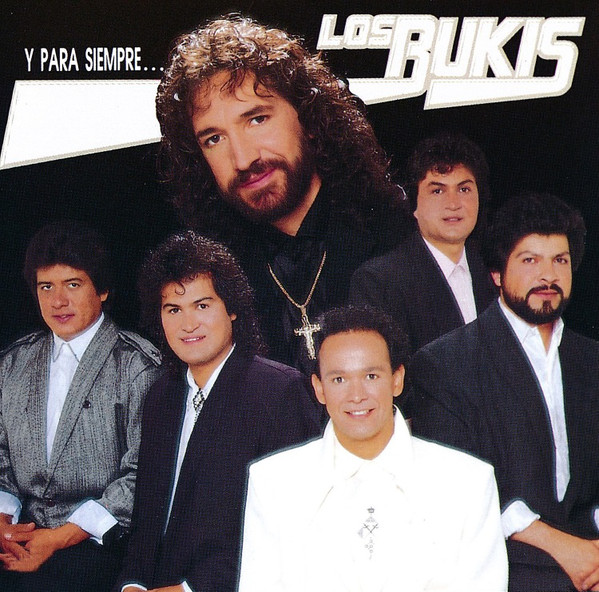
There's something about Los Bukis that makes it hard for me to even want to grapple with their music. Not hard to listen to their music — it goes down easy, just like it was made to — but to pay attention to it and consider it and give it due weight and render a fair and sober judgement. This isn't even about how I don't like it. I like it fine! Or I would if I had any thoughts about it at all. Instead I spent their last appearance talking about them (not the song) and now I'm spending this one talking about me (not the song).

As has become my habit, I translated the lyrics into English in a Notepad document before opening this post, just so I could make sure I wasn't missing anything important. I wasn't — they're standard bleeding-heart lyrics about the anguish of unrequited love, with one or two nice images and a whole lot of standard lines. I bet this is a great song to blast at full volume in your room or your car when la única chica no te quiera, but without that motivating emotional hook, it only rings bombastic and faintly ridiculous to me now.

This is the third ballad in a row with an electric guitar solo, which means I'm pretty dumb, but it also means that we're definitely turning into the 90s now. I remember early-90s ballads as being chock full of pointless electric guitar solos (most egregiously on the Vanessa Williams/Brian McKnight duet "Love Is"), and at least as far as Latin Pop goes, that's looking like a trustworthy memory.

And I think that's all I have to say. Next time I'll try to talk about the actual music; I just have to post this so I can get past it and jump-start this blog again.

15.4.10

CHAYANNE, “FUISTE UN TROZO DE HIELO EN LA ESCARCHA”

4th November, 1989


The second temperate ballad in a row to be interrupted by a flash of electric-guitar wizardry; is this a slow-rolling sea change, or merely something which had never before bobbed to the surface? But comparisons with the Luis Miguel song which preceded it are not likely to be very fruitful; after all, once you've noted the difference in the singing styles (Miguel: all-out passion, Chayanne: so sweet as to maybe be called simpering), the similarities in topic (both are anguished farewells to dangerously fickle women that use images of ice and treachery), and a general structural similarity (which either of them would share with ninety percent of ballads produced in the last quarter of the century), what's left to compare?

That's meant for humor. Unfortunately there is a sameness to much of the music we've been discussing over the past several months, a sameness which stands out all the more to ears that have not really been trained to pick out the nuances, and who hasn't followed the breathless press about each new estrella fabulosa. But Chayanne's going to be around a while; let's see what there is to know about him.

He's of the same generation of pop stars as Luis Miguel; when Miguel had his first #1, Chayanne was right behind him at #4. If his own summitting took a little longer, well, he had more irons in more fires. As un estrella de pop puertorriqueño, he also got jobs in the island's telenovela industry. We'll get to his crowning glory in that field -- in fact, one of the absurd crowning glories of all Latin pop culture -- in a few years' time, but for now, note that his dreamy swoon-worthiness is as much televisual as musical. Also, his birth name was Elmer.

I'd engage the song more, but the snark above pretty much nailed it. I'll just translate the title as per usual: "You Were A Piece Of Ice In The Frost." Which sets us up for a much more poetic lyric than the one we actually get, but pop has always been as much about hollow promises as about glory fulfilled; frequently more so.

12.4.10

LUIS MIGUEL, “FRÍA COMO EL VIENTO”

21st October, 1989


I may just be balladed out. But it's difficult for me to hear much in this song except a lot of grimacing emoting, which the video bears out. (Luis Miguel watch: it was clearly shot before the one for "La Incondicional," as witness his uneven mop of hair, and I'm left wondering if was promoted first but took longer to get to the top, thanks to the vagaries of the airplay market.) The backing is thin and conventional, the only faint surprise being a brief electric guitar solo, which is quickly replaced by a saxophone.

That solo is hardly revolutionary or even interesting by Anglo pop standards, but the electric guitar could have decadent, imperialist-American connotations in much of Latin America up through the 80s. Rock en Español was far more upsetting in the context of its home audience in the 80s and 90s than the Anglophoners who embraced it with a patronizing "about time you caught up" air (even as rock lost unrecoverable ground in England and America) could possibly have understood. But we'll have plenty of time to explore that later; for now, just note the almost dangerous sophistication it represents in this song.

The dangerous sophistication, it is to be understood, is not on the part of Miguel himself, who is a nearly invisible presence in his own song. (At least as much as he can be, with that creamy voice emoting so hard all over the place.) The lyrics place an unknowable, untouchable woman at the center, and wind so thickly around her in metaphor and simile that seeing the anonymous model-dancer in the video is an inevitable letdown.

The title translated to English is "Cold As The Wind," and the chorus continues, "dangerous as the sea/sweet as a kiss/Don't let yourself love, because/I don't know if I have you/I don't know if you come or go/You're like an unbroken colt." (Luis Miguel expressing iffy sentiments about women watch: are those supposed to be good things or bad?)

As has been the general rule throughout this travelogue, romantic sentiments inevitably sound even more romantic (or ridiculous!) when written in Spanish, because they're expressed in idioms and images which are unfamiliar or old-fashioned in English. An English-language power ballad about a "cold," "vain, capricious, ideal" woman would be unlistenable; in Spanish, the language is only slightly more heightened than normal for pop.