Showing posts with label los bukis. Show all posts

27.12.10

MARCO ANTONIO SOLÍS & LOS BUKIS, “UNA MUJER COMO TÚ”

3rd June, 1995


Los Bukis are back! It's been a while since we've heard from them, and in the meantime they've undergone a name change. Marco Antonio Solís, who was always the frontman, songwriter, face, and leader of the band, is billed up front now; the next time we see him, he'll have left behind the Bukis brand entirely.

But if the band was ever more than a collection of guys who played behind Solís, this is a great note for them to go out on. Listening back to their appearances in this travelogue, they've been more consistent than I think I gave them credit for at the time; back to back, their songs form a sort of interlocking pattern of trad-inflected Mexican pop, moving from the synth-heavy production of the 80s to the rhythm-centric production of the 90s. Of course, there were solid rhythms on their earlier songs, and there are synths here. Maybe the real difference is that the trad is just a little more inflected than previously.

The song is a bolero, and Solís gives it the rich, full vocal that bolero tradition demands — and I'm pleasantly surprised. This is the first time I've been impressed by his singing; not that he's Luis Miguel all of a sudden, but especially on the middle eight, where he has to make a difficult leap alone, he acquits himself so well that you can see exactly why he felt that the band wasn't necessary any more. Still, the sensitive arrangement and tasteful guitar and percussion figures enhance the pleasure, and if this isn't quite in the Gloria Estefan range of superbly evocative traditionalism, it's dreamy enough to do.

26.7.10

LOS BUKIS, “MI MAYOR NECESIDAD”

21st March, 1992


Another year, another Los Bukis chart-topper. Like the countrypolitan acts of the 70s and 80s I keep comparing them to, they're dependable, comfortable, reassuring. You always know what you're going to get.

Or maybe they can surprise you sometimes. Los Bukis sound here for the first time like the regional band I keep tagging them as; not just in the chord structures and the romantic sentiments, but instrumentally too: the classically-derived norteño guitar solos are both a signifier of Serious Intent and a soothing relief after a rather numbing procession of gloopy keyboard ballads. I know I've been grumbling about ballads a lot here, to the point where even I'm sick of the very word, but I love the dazzling variety of Latin music so much that it's really frustrating to hear so much of it represented by this travelogue as sounding the same.

But as to the Serious Intent: the opening of the video, with its heartwarming cascade of Mexican humanity, will do better than anything else to explain what writer-singer Marco Antonio Solís and company were getting at (and Solís' hair, at its early-90s finest, has to be seen to be believed). It's a love song — an obsessive, can't-get-you-out-of-my-head love song, but a love song — but Solís' spoken intro, the kind of inclusive stage patter that's second nature to any professional entertainer, encourages all of his listeners to hear themselves in the song, so that it's as much an ode to the band's fans as to a woman. Los Bukis were undoubtedly the biggest romántico band in Latin Pop by this point; that this is (spoiler alert) their last appearance here under the band name is as much testament to the irresistible logic of pop hubris as it it is to the various machinations which we'll catch up on the next time we come to Marco Antonio Solís.

24.6.10

LOS BUKIS, “MI DESEO”

11th May, 1991


Their third album in a row, and their third number one hit in a row — Los Bukis have, in the short space of time that the Hot Latin chart has been in existence, become an institution. And more and more my categorization of them as a "regional" band is slipping away from accuracy; Wikipedia calls them a "romantic" band, and I'm sure it knows better.

But I've drawn the comparison before between regional Mexican music and country music, and this is a fantastic country song, the sort of thing that George Jones in his imperial phase (1969-1982, give or take) would have loved to get his teeth into, a double-reverse narrative that is also nothing but a list of wishes. Marco Antonio Solís, the band's songwriter, singer, and prime mover, spends two verses coming on like Tom T. Hall in "I Love," as he wishes ("Mi Deseo" means "my wish") for universal peace, happiness, and the realization of each individual person's complete good. Then, as the drumpads hit and the chord changes up to the bridge, he sings — well, here's my translation:
But for you, I wish that nobody would be with you
And that sadness envelops you and drags you into bitterness
That everything will be cold, that you weep, that you never feel safe
That when you look at your bed, you see your tomb
Which that right there, oh snap, but he's not finished. The final verse continues:
I wish that you never hear truthful words where you walk
That the whole world turn its face from you, that no one understand you
And although it seems as though you're listening to your worst enemy,
My wish is that soon, you'd return to me
Aw, he's only saying these things because he misses her! How sweet! But nevertheless creepy! And your ultimate judgment of the song depends on how comfortable you are with unreliable narrators.

There's a Tex-Mex drag to the music, a sob in Solís' voice, and the kind of stately build to the melody that recalls old-time hymnody, all of which scream "country" to me, but of course the instrumentation is as synthetic and untraditional as the 80s could wish. Like I say, I'd love to hear George Jones (or maybe Raul Malo) sink his teeth into it. It's the kind of song that could, with the right treatment, become a modern pop-noir classic.

19.4.10

LOS BUKIS, “CÓMO FUÍ A ENAMORARME DE TÍ”

9th December, 1989


There's something about Los Bukis that makes it hard for me to even want to grapple with their music. Not hard to listen to their music — it goes down easy, just like it was made to — but to pay attention to it and consider it and give it due weight and render a fair and sober judgement. This isn't even about how I don't like it. I like it fine! Or I would if I had any thoughts about it at all. Instead I spent their last appearance talking about them (not the song) and now I'm spending this one talking about me (not the song).

As has become my habit, I translated the lyrics into English in a Notepad document before opening this post, just so I could make sure I wasn't missing anything important. I wasn't — they're standard bleeding-heart lyrics about the anguish of unrequited love, with one or two nice images and a whole lot of standard lines. I bet this is a great song to blast at full volume in your room or your car when la única chica no te quiera, but without that motivating emotional hook, it only rings bombastic and faintly ridiculous to me now.

This is the third ballad in a row with an electric guitar solo, which means I'm pretty dumb, but it also means that we're definitely turning into the 90s now. I remember early-90s ballads as being chock full of pointless electric guitar solos (most egregiously on the Vanessa Williams/Brian McKnight duet "Love Is"), and at least as far as Latin Pop goes, that's looking like a trustworthy memory.

And I think that's all I have to say. Next time I'll try to talk about the actual music; I just have to post this so I can get past it and jump-start this blog again.

26.2.10

LOS BUKIS, “Y AHORA TE VAS”

23rd April, 1988
We're still on the earlier legs of our journey, early enough for me to still be obsessed with marking firsts. And this is two big ones: the first real regional (pronounced rayhee-oh-NAL) song, which I'll get into later, and our first encounter with a man who will be a more-or-less constant companion throughout the next two decades: Marco Antonio Solís.

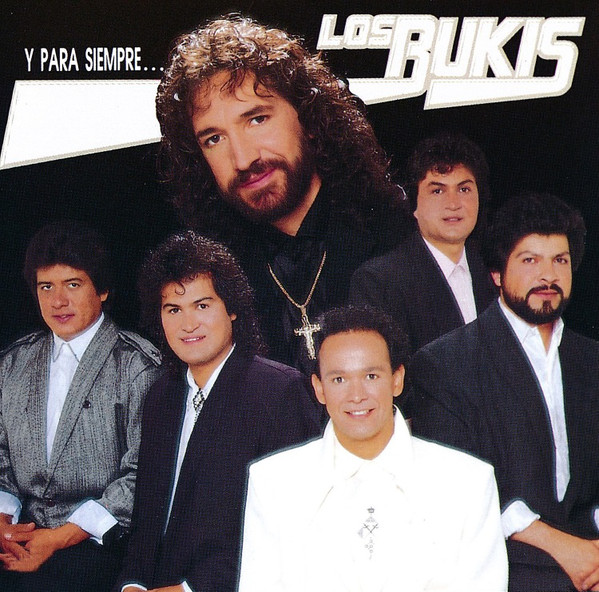
Solís, with his cousin Joel, founded Los Bukis in the early 70s in Michoacán, one of Mexico's southwestern states. From their first single ("Falso Amor," 1975) they became one of the most popular bands in the country, with strong followings in the United States and Puerto Rico. Their name means "the kids" in the Yaqui language of northern Mexico, and that identification with the indigenous underclass (however superficial) pointed to the sort of panamericanismo to which most Latin Pop stars would at least pay lip service in the years to come.

But Los Bukis were no trad outfit, singing old songs in old styles and busking for tourist dollars. (It's worth noting here that the questions of authenticity and keeping-it-realism which exercise so many commentators in the American and Anglo pop spheres have very little to do with how Third World pop stars actually make use of their own native pop forms. Solidarity with the poor is better expressed financially than through canons of taste.) Their regionalismo was a glossy, uptown take on the country-fried rancheras and corridos, with plush up-to-date instrumentation and a versatile, tempered instrument in Solís' lead vocals. Like a Mexican version of the countrypolitan movement of the 1960s, Los Bukis gave their listeners a thoroughly Mexican, thoroughly modern music that worked just as well in the bustling urban centers as in the open spaces of the countryside: an aspirational music for the emerging middle class on both sides of the border.

"Y Ahora Te Vas" ("and now you leave") was written by Solís, who wrote nearly all the group's material (his going solo several years down the road, spoiler alert, was less an escandalo de pop than a foreordained conclusion; no one flocked to Los Bukis concerts to see the other guys), and is a solid if unpretentious regional song. My comparison of the genre with country music in the American market is both illuminating and misleading; like country, regional relies on specific images to tell universal stories, but unlike country it's not really relegated to a specialized market (at least in Mexico, and since we're telling the story of Latin Pop in the U.S., there's going to be a lot of overlap with the story of Mexican pop).

It's a breakup song, the kind that George Jones did so well — "and now you're leaving, knowing I couldn't find/The motive in your soul, the love I feel for you/To whom will you give everything you never gave to me/Who will cry for you, as I do, some day" — the faithless beloved throwing over our creamy-voiced hero, but he'd take her back in a heartbeat nevertheless. The instrumentation is dominated by cheap synthesizers, but in 1988 that still coded as uptown, classy, and American in regional music. The occasional interpolation of regionalismo into our story has its own story of change, cool, and identity which doesn't always correspond with the shifts in the larger Latin Pop scene. But more about that when we come to it.