Showing posts with label rudy perez. Show all posts

6.8.18

JENNIFER PEÑA, “VIVO Y MUERO EN TU PIEL”

29th May, 2004

Wiki | Video

If Jennifer Peña's career proceeded in emulation of Selena's, this might be the point where Selena's ended: with a frosty, devotional ballad. But Jennifer never crossed over to the English language, preferring to remain resolutely, and indeed polyphonically, Latin -- the regionally-aimed cumbia version of the song also had a video, in which her hips move with much greater freedom than they do in the canonical ballad version -- and this is her last appearance in our travelogue. She would only issue one more studio album, and then marriage (to Obie Bermúdez?!), her recording contract going into legal limbo as a result of label mergers, and finally a turn to Christian music would sideline her pop career for good.

The parent album, Seducción, also featured a salsa version of this song among its bonus tracks, because although the recording industry was undergoing the precipitous slide from its millennial peak, diversification was still a good bet. But it was the pop ballad version that was the hit, judging by its view count (although the cumbia version sounds much more lively and interesting at a remove of fourteen years), and Rudy Pérez's mooning lyrics about the overwhelming, totalizing way that the early stages of a crush affects the enamored one only really make sense in a ballad form: in the cumbia, such lugubriousness ring hollow among so much boot-scooting good cheer.

"Vivo y Muero en tu Piel" means "I live and die in your skin," a striking image that, in the context of the song, is really just an elaboration of the "whither thou goest, I will go" of Ruth 1:16. And I'm reminded again of how much more sensual, how much more willing to consider physical bodies and mention skin and flesh, Latin pop is than Anglo pop. The fundamental Gnosticism of American religion, its pretense that love can be purely an intellectual-emotional exercise without corresponding physicality, casts long shadows.

4.12.17

JENNIFER PEÑA, “EL DOLOR DE TU PRESENCIA”

24th August, 2002

Wiki | Video

The hunger, as much spiritual as commercial, for a replacement for Selena had been an undercurrent of the Latin music industry since her death. One of the likeliest candidates was Jennifer Peña, whose first large-stage performance had been at a Selena tribute concert at the Astrodome in 1995, when she sang "Bidi Bidi Bom Bom" at eleven years old. She was already being managed by Selena's father; her debut album as a singer fronting Jennifer y los Jetz,  would be released the following year.

But like Selena herself, her career was less one of meteoric success than of constant work, slow movement forward, and gradual leveling-up. Libre, released in 2002 when she was eighteen, was her fifth album, but the first attributed entirely to her name and also the first after jumping from EMI, where the Quintanillas had signed her, to Univision, which had also broken Selena widely in 1993. She retained the cumbia sound which was her signature, but with production from Rudy Pérez and Kike Santander, aimed more squarely at the broader Latin Pop market.

It worked, clearly. "El Dolor de Tu Presencia" (the pain of your presence) is both a lush r&b ballad and a skanking cumbia jam, with pure pop harmonies and a bassline that won't stop. Although it was written by Rudy Pérez, it's very much a teenager's song, moaning about how the boy she's in love with is in love with her best friend, tearing their friendship apart and causing her pain. Still, it's smartly produced and sung with a warmth older than her years.

A power-ballad pop version, all swelling strings and crashing drums, was also released, which no doubt had a lot to do with bringing it to #1 (cumbia remained popular on the border, but not necessarily in the larger US Latin Pop market), but the cumbia rendition made the video, which cuts shots of her mooning over the love triangle with shots of her dancing in front of her cumbia band, acknowledging that after all, everything's a performance.

13.11.17

PILAR MONTENEGRO, “QUÍTAME ESE HOMBRE”

30th March, 2002

Wiki | Video

In the years immediately predating the reign of reggatón (a reign which has mutated and transformed enough that it's now possible to talk of reggaetón generations, but that's for the future), Puerto Rican music made itself more and more central to the Hot Latin #1 spot. It had always shown up there -- Puerto Rico was the third most frequently represented nation in US-oriented Hispanophone pop behind Mexico and the mainland US -- but in the 90s whole years went by without PR representation. The gravitational well around Ricky Martin surely had something to do with it, but improving economic conditions on the island around the turn of the century also helped: the generation of Puerto Ricans who had helped create salsa in the 50s, 60s and 70s were giving way to a new generation less geographically bound to either New York or San Juan, more internationalist in both outlook and reception.

Which may be an odd way to start off a song from a Mexican singer. But "Quítame Ese Hombre" (Take That Man Away from Me), a cover of a 1988 single by Puerto Rican pop singer Yolandita Monge, written by the great Cuban songwriter José Luis Piloto, a rather stately and high-toned request that the singer's new lover erase all traces of the old, unsatisfactory one. For Pilar Montenegro, no doubt, the song's non-Mexican provenance mattered not at all: she wanted a good, familiar tune which her throaty delivery and skimpy video outfits could adorn. Her primary career has been as an actress, primarily in telenovelas, and this is her sole appearance on the travelogue.

With all due respect to her vocal and self-promotion talents, that appearance is probably due more than anything else to the production of Cuban-American Rudy Pérez, whose production work has regularly appeared here (he ran in Estefan circles during the 80s), sometimes noticed and sometimes not. Listening to Yolandita Monge's and Pilar Montenegro's versions of the song back to back is an education in production shifts from the late 80s to the early 00s: if the 80s sounds better today, that has more to do with fashion trends than with the skill or acumen of the producer.

4.9.17

JACI VELÁSQUEZ, “CÓMO SE CURA UNA HERIDA”

1st September, 2001

Wiki | Video

Christian pop singer Jaci Velásquez makes her second appearance in this travelogue with a song that backs even further away from the only vaguely cool sound of her first: this is straight melodramatic balladry, with none of "Llegar a Tí"s light syncopation, crisp guitars, or silky MDO background vocals. There are strident drums, wispy guitars, and on the last chorus massed-choir background vocals -- but the affect is entirely different; where "Llegar" was an expression of (tasteful) joy, "Herida" is all about chest-beating pain.

Fan gossip is that the song is a pained-but-faithful response to her parents' divorce, and indeed the lyrics are full of wounded betrayal (the title means "How Is a Wound Healed") and, eventually, reconciliation through the sublimation of faith; but the song wasn't written by Velásquez, and it can easily be transposed onto a the failure of romantic or even sheerly platonic relationships.

It's full of the kind of banalities that aren't at all banal when you're in a position to express them, which means that despite the dull production and duller sentiments, her performance is genuinely moving, using both the high-octane belt required of any contemporary Christian singer and a lighter, more emotional register that owes a very slight (but real) debt to the emotional vocalizations of ranchera singers. It's not much, but it's something.

18.6.17

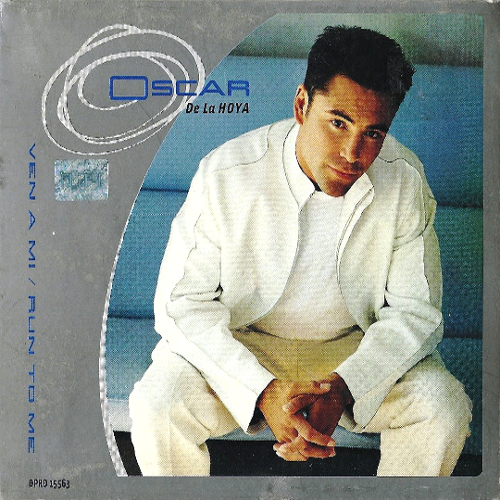
OSCAR DE LA HOYA, “VEN A MÍ”

28th October, 2000


Yep, the boxer. And if you've clicked through to the video, yep, that's the Bee Gees' "Run to Me." The turn-of-the-century Latin wave had unsettled things so much that an athlete's vanity album could be one of the year's biggest sellers. On the other hand, it was produced by Rudy Pérez, with writing contributions from Diane Warren, so it was very much part of the Latin pop of the era (it was recorded when he was wooing Millie Corretejer, who we met briefly last year; they remain married). So a vanity album, but  a well-funded and properly marketed one: the English-language version of the song got a bit of Anglo adult-contemporary play, while this Spanish-language one did so well that it turns up here.

De La Hoya's voice wasn't particularly strong, but neither are lots of pop stars'. The production is, charitably, generic adult-contemporary of the period. The lyric is a one-to-one translation of the original, and just as sappy and generic, and the harmonies, produced by session singers, are ported directly over from the Brothers Gibb's.

And that's about all I have to say about it. This will, unsurprisingly, be the last we see of the Golden Boy.